




Sustainable Tourism in Krabi: How You Can Make a Difference
 Railay Eco
Sustainable tourism in Krabi starts with you. Pick a licensed operator, don't touch or step on coral, use reef-safe sunscreen, take your trash back, and support local people. These small choices add up. Together they help keep Krabi's sea and forests beautiful for the people who come after you. This guide covers the real things a traveler can do, plus why each one matters.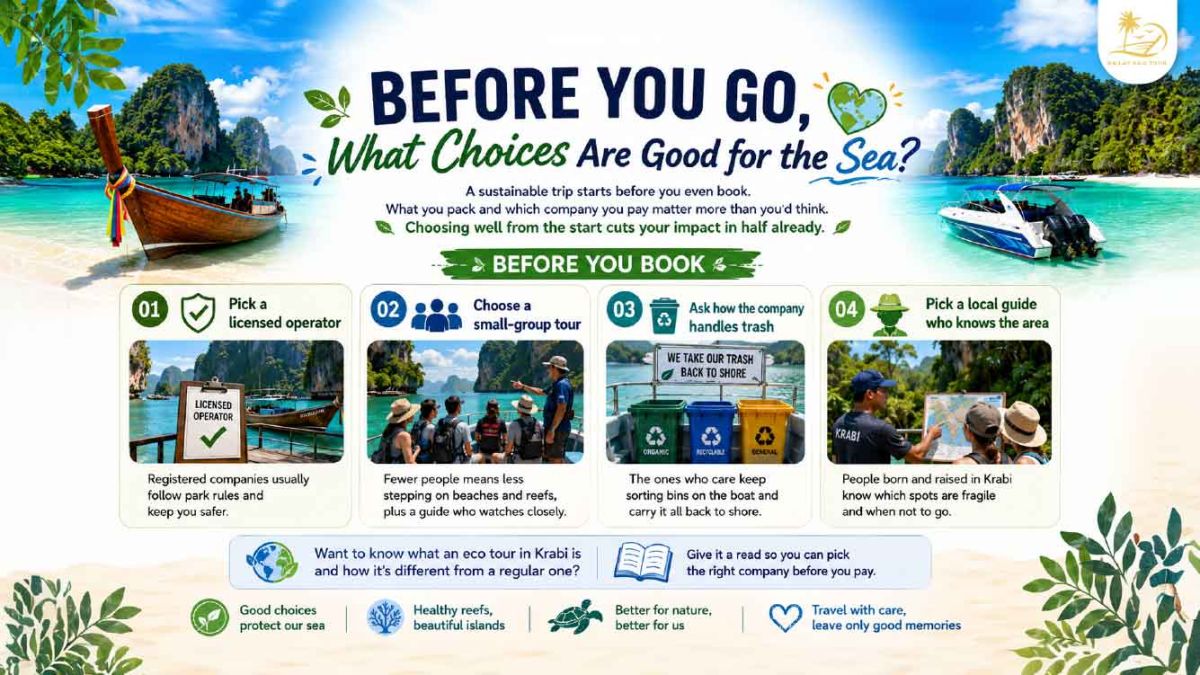
What Does Sustainable Tourism in Krabi Really Mean?
Lots of people think traveling green has to be hard or cost more. But it just means traveling without leaving a mess for nature and local people. You still have tons of fun. You just pick the way where the sea, the forest, and the locals don't pay the price later. Krabi has national parks, coral reefs, and fishing villages that all rely on nature for a living. When a spot gets ruined, the first people hurt are the ones who live there. So traveling with care isn't only about nature. It's about people too.
Picture a coral reef that takes decades to grow. It can get wrecked in one day by a few people stepping on it. Or a sandbar that only shows up at low tide, but it's covered in trash people left behind. These things really happen when crowds travel without thinking about what comes next. The good news? The thing that wrecks nature fast is the same thing that's easiest for us to change. It's how we act as travelers. Once you see that every small action counts, traveling the sustainable way becomes something you can do right now. You don't have to wait for anyone.
Before You Go, What Choices Are Good for the Sea?
A sustainable trip starts before you even book. What you pack and which company you pay matter more than you'd think. Choosing well from the start cuts your impact in half already.
Before you book
- Pick a licensed operator because registered companies usually follow park rules and keep you safer
- Choose a small-group tour since fewer people means less stepping on beaches and reefs, plus a guide who watches closely
- Ask how the company handles trash because the ones who care keep sorting bins on the boat and carry it all back to shore
- Pick a local guide who knows the area since people born and raised in Krabi know which spots are fragile and when not to go
Want to know what an eco tour in Krabi is and how it's different from a regular one? Give it a read so you can pick the right company before you pay.
What to Pack and What to Skip
Getting ready the right way at your hotel cuts a lot of the trash and chemicals that end up in the sea. The trick is simple. Pack stuff you can reuse, and skip stuff you throw away once.
| What to pack | What to skip |
|---|---|
| A refillable water bottle | Single-use plastic water bottles |
| Reef-safe sunscreen | Sunscreen with reef-harming chemicals |
| A cloth bag and a food box | Plastic bags and foam boxes |
| A long-sleeve sun shirt | Thick sunscreen that washes off in the water |
| A small bag for your own trash | Leaving trash on the island |
Swapping just a few things in your bag means you won't leave a mark on islands that have no trash bins and no one to clean up.
How Should You Act While You're at Sea?
The time you're out at sea and on the islands is when your actions matter most. The things you can do are easy but important. Just a few. Remember them and you're set.
While on the islands and in the water
- Don't touch or step on coral because coral is a living thing that grows super slowly, and once it breaks it takes years to come back
- Don't feed the fish or sea animals since feeding throws nature off balance and changes how fish behave
- Take every piece of trash back because most islands have no one to clean up, and dropped trash hurts the animals
- Keep your distance from wildlife like monkeys, birds, and turtles, you can look but don't get close or touch
- Respect the sandbars and the tides since spots like Talay Waek only show up at low tide, so don't push it when the water is coming in
Do these few things and Krabi's reefs and sea animals will still be there for the people who come after you, just like you saw them.
Why Do Souvenirs and Supporting Locals Matter?
The money you spend on a trip says what you support. When you pay local people and skip things that hurt nature, you help the community get by without harming the sea. Krabi has small family-run food stalls, handmade local crafts, and guides who were born and raised here. When the money goes back to these people, they have a reason to protect nature. A healthy sea and forest is what feeds their families. So choosing where you spend is a much more powerful tool than most people think.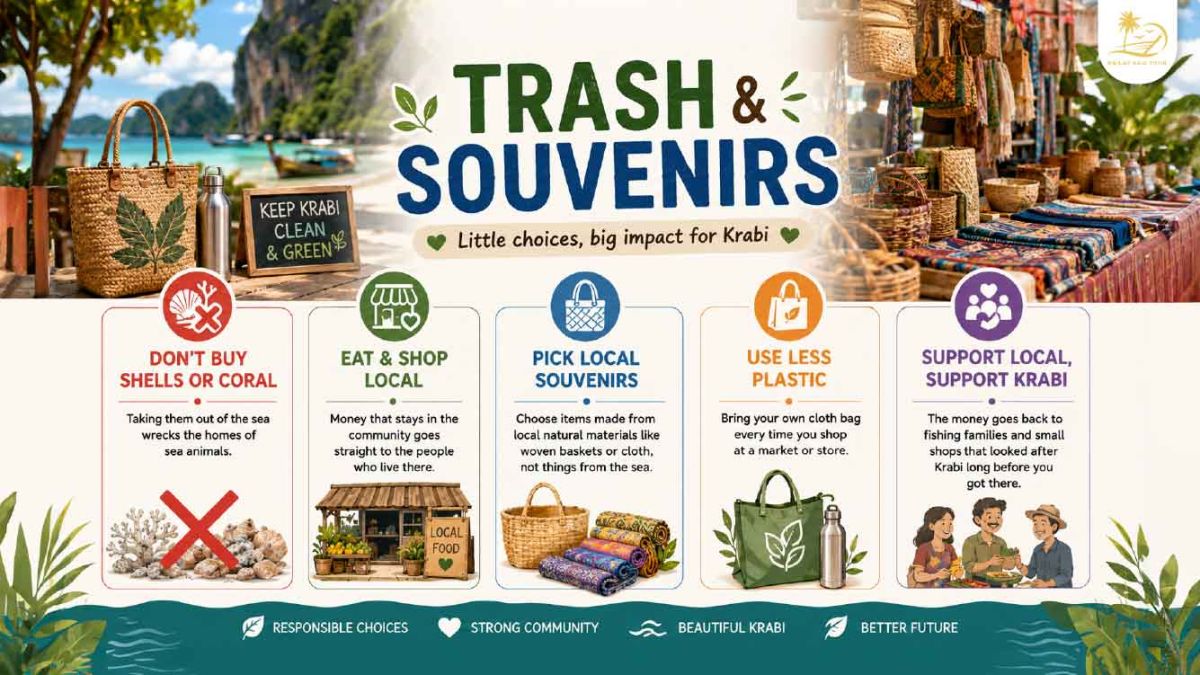
Trash and souvenirs
- Don't buy shells or coral as souvenirs because taking them out of the sea wrecks the homes of sea animals
- Eat and shop at local spots since money that stays in the community goes straight to the people who live there
- Pick souvenirs made from local natural materials like woven baskets or cloth, instead of things made from the sea
- Use less plastic when you shop by bringing your own cloth bag every time you stop at a market or store
When you support local people, the money goes back to fishing families and small shops that looked after Krabi long before you got there.
Travel Krabi With a Tour That Cares for the Sea and Community
The heart of a sustainable trip is having someone who really knows the area take you around. Our local guides were born and raised in Krabi. So they know which spots are fragile, when the tide comes in and out, and which bays you can enter without bothering nature. Want to see what local Krabi guides show you that a regular tour skips? You'll find that local people help make a trip both fun and kind to nature at the same time.
We run small-group tours to cut the stepping on beaches and reefs. Our boats carry sorting bins and bring the trash back to shore every time. We take our guests around without feeding the fish or getting too close to wildlife. We do it because we want Krabi's sea to stay beautiful when the kids who live here grow up.
Want to travel without leaving a mark and support local people at the same time? Message our team to plan an eco-friendly Krabi trip that picks the spots and the pace to fit both you and nature.
Travel Krabi the Sustainable Way, Starting Today
Sustainable tourism in Krabi isn't far away. Start by picking a licensed operator and a small-group tour, packing reusable stuff, and using reef-safe sunscreen. That alone cuts your impact before you even get on the boat.
While you travel, keep it simple. Don't touch coral, don't feed the fish, take every piece of trash back, keep your distance from wildlife, and respect the tides on the sandbars. Finish by shopping at local spots and skipping shells or coral as souvenirs.
Want to know why premium versus budget tours don't look after nature the same way? Give it a read before you pick a trip for the days you're here.
Frequently Asked Questions
What does sustainable tourism in Krabi mean?
It means traveling without leaving harm for nature and the community to carry. Like picking an operator who looks after the area, cutting the trash that ends up in the sea, and supporting local people. You still have a great time. You just choose the way that keeps Krabi's sea and forests in good shape for the next people to see.
Can one traveler really make Krabi more sustainable?
Yes, because Krabi gets a huge number of travelers each year. If each person cuts their trash, doesn't step on coral, and supports locals, the total is massive. One person's small action might look tiny. But when lots of people do the same thing, the reefs and beaches get to rest and bounce back.
What kind of sunscreen is safe for Krabi's sea?
Pick a sunscreen labeled reef-safe, because some chemicals in regular sunscreen can bleach and kill coral. Another easy fix is to wear a long-sleeve sun shirt instead of putting on thick sunscreen before you swim. That cuts the amount of chemicals that wash straight into the sea.
Why shouldn't you buy shells or coral as souvenirs?
Because shells and coral are part of the sea's ecosystem. Taking them out to sell costs sea animals their homes and wears the reefs down. The more people buy them, the more get pulled from the sea. Picking souvenirs made by local hands helps both the community and the sea at the same time.
How are small-group tours better for the environment than big ones?
Small-group tours have fewer people stepping on beaches and reefs, so spots stay less crowded and bounce back faster. The guide can also watch everyone, reminding them not to touch coral or feed the fish, which is harder with a big group. The result is good for both the travelers and nature.
References
- Wikipedia: Sustainable tourism: what green travel means
- Wikipedia: Krabi Province: Krabi geography and nature
- DASTA Thailand: sustainable tourism guidelines
- Tourism Authority of Thailand: official Thai tourism body
Poda Island is a small island in Krabi province, south of Ao Nang — roughly 20 to 30 minutes by longtail boat or about 15 minutes by speedboat. What stands out is the fine white sand and the water, which stays shallow on a long gentle slope.
 Railay Eco
Pileh Lagoon sits on Phi Phi Leh in Krabi province — a bay almost completely ringed by tall limestone cliffs, with one narrow gap for boats to pass through. No swell reaches inside, so the water sits still, and the white sand floor below reflects the light back as emerald. Every trip to Phi Phi Leh stops here, because it is only minutes from Maya Bay.
Railay EcoKrabi Airport sits roughly 15 kilometres from Krabi town and 30 to 40 minutes by road from Ao Nang. To reach Ao Nang you can take the airport bus, a shared minivan, a taxi, or a private transfer booked in advance. Railay is a different matter: it is a peninsula no road reaches, so you take a vehicle to a pier and then a boat. The mistake people make most often is landing late and finding the last boats into Railay already finished for the day. This guide covers each transport option, journey times, rough costs, and how to handle a late arrival.
Railay EcoNopparat Thara Beach is in Krabi town district, immediately west of Ao Nang — five to ten minutes away on foot or by car. It runs for several kilometres, holds far fewer people than Ao Nang, and has the national park headquarters sitting right on the sand. The detail most visitors miss: at the lowest tides a sandbar emerges and you can walk out to the small island offshore without a boat. It also serves as a departure point for some island routes, so it works both as a place to rest and as a way out to sea. This guide covers how it differs from Ao Nang, how to get there, and when to go.
Railay EcoHong Island belongs to Krabi province and sits inside Than Bok Khorani National Park, north of Ao Nang — roughly 30 to 40 minutes by speedboat, or about an hour by longtail. What makes it different from the other Krabi islands is the lagoon in its middle: a pool of water almost entirely enclosed by tall limestone cliffs, with one narrow opening that small boats can slip through when the tide is high enough.
Railay EcoThe Emerald Pool sits in Khlong Thom district, Krabi province, roughly 60 to 70 kilometres from Krabi town — about an hour to an hour and a half by car. It is a natural pool clear enough to see the sand on the bottom, coloured green-blue by minerals in the groundwater and the light filtering through the canopy. From the car park you walk about 800 metres along a forest path. The path is mostly flat and comfortable even with children or older travellers. Two places most people pair with it on the same day: the Hot Springs nearby, and the Blue Pool a further walk in from the Emerald Pool itself. This guide covers the route, the entrance, the walking distances, and when the water is at its clearest.
Railay Eco