




What Is an Eco Tour in Krabi? How Is It Different from a Regular Tour?
 railay team
An eco tour in Krabi is a tour built to do as little damage to the environment and local community as possible. It uses electric boats or fuel-efficient ones, limits the number of guests per trip, picks up trash along the way, and hires local guides to spread income to the community. It costs 20 to 40 percent more than a regular tour but gives a deeper experience with less impact on nature. This guide explains the meaning, the 7 core rules, how to pick the right operator, and how it compares to regular tours.
What Exactly Is an Eco Tour?
Eco tour (or ecotourism) means a kind of travel built to do the least damage to the environment and local community, while giving travelers a deep experience and real learning. It's different from regular tours that focus on the highest number of guests and biggest profit, without thinking about impact.
The United Nations World Tourism Organization defines eco tour as "travel to natural areas that conserves the environment, supports local livelihoods, and educates travelers." This is the standard that certified operators must follow.
Eco tours in Krabi started because mass tourism killed corals, ruined beaches, and changed community life. Operators who saw the problem started using new, more sustainable methods.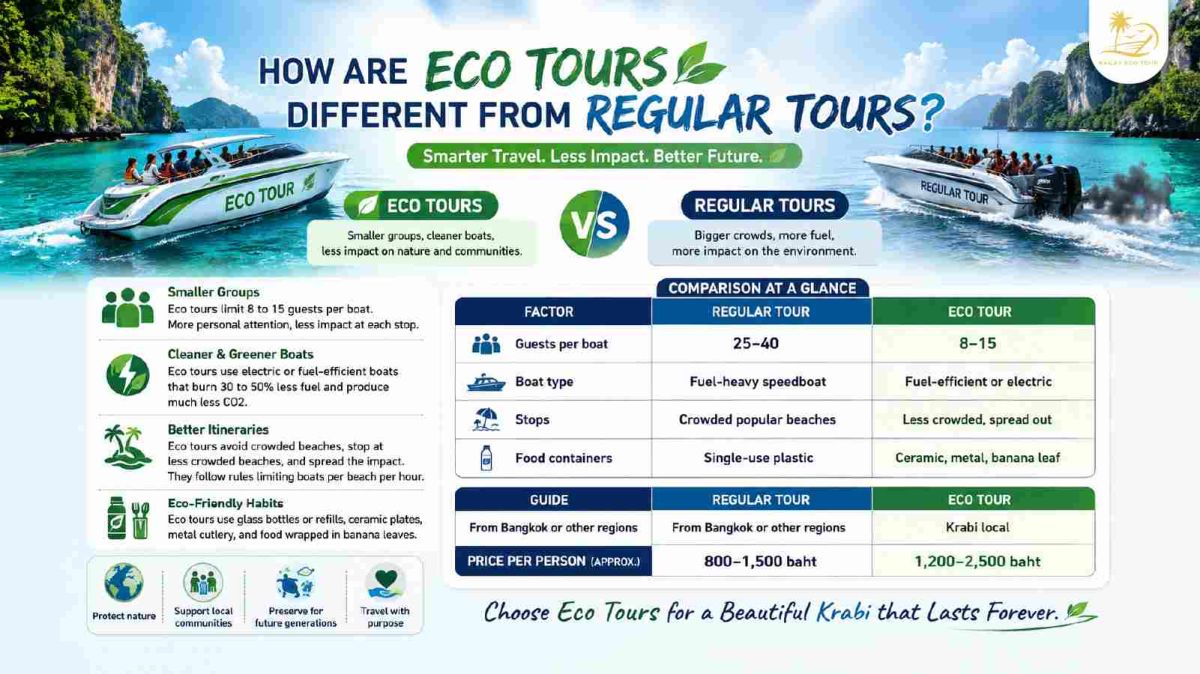
How Are Eco Tours Different from Regular Tours?
The biggest difference is the number of guests per trip. Regular tours pack 25 to 40 people per boat. Eco tours limit it to 8 to 15 per boat. This reduces impact at each stop and lets the guide give attention to everyone.
Regular tours use speedboats that burn lots of fuel for speed. They emit high CO2 per person. Eco tours use electric boats or fuel-efficient boats that burn 30 to 50 percent less fuel. They also run slower to save fuel.
Regular tours stop at the popular crowded beaches because it cuts the cost of scouting new ones. Eco tours stop at less crowded beaches and spread the impact. They also follow rules limiting the number of boats per beach per hour.
Regular tours use single-use plastic for water, food boxes, and cutlery. Eco tours use glass water bottles or refills from big tanks, ceramic plates, metal cutlery, and food wrapped in banana leaves.
| Factor | Regular Tour | Eco Tour |
|---|---|---|
| Guests per boat | 25-40 | 8-15 |
| Boat type | Fuel-heavy speedboat | Fuel-efficient or electric |
| Stops | Crowded popular beaches | Less crowded, spread out |
| Food containers | Single-use plastic | Ceramic, metal, banana leaf |
| Guide | From Bangkok or other regions | Krabi local |
| Price per person | 800-1,500 baht | 1,200-2,500 baht |
The 7 Eco Tour Rules Operators Must Follow
Eco tour rules in Krabi follow international standards from Green Globe Certification and Travelife Certified.
1. Limit Guests Per Trip
Maximum 15 guests per boat for nearby Krabi islands. Maximum 25 per boat for Phi Phi and Lanta trips. This cuts impact at each stop and lets the guide watch everyone.
2. Use Low-Impact Boats and Vehicles
Boats must pass CO2 emission checks and use less than 8 liters of fuel per guest per trip. Electric boats on short routes. They run 20 to 30 percent slower than regular tours.
3. Pick Up Trash Along the Way
The guide and boat driver must pick up floating trash and beach trash every trip. Each trip collects 5 to 15 kilograms. They bring it back to the pier for proper disposal, including recycling of plastic, paper, and glass.
4. Use Krabi-Born Local Guides
At least 80 percent of the team must be Krabi locals. This spreads income back to the community. Locals know the real lifestyle and history. And they don't make the local culture change.
5. Support Local Restaurants
Every trip that includes a meal uses restaurants owned by locals. No chain restaurants or outsider-owned shops. This sends income directly to the community.
6. No Stepping on or Touching Corals and Sea Life
Guests must learn the rules before getting in the water. No sunscreens with Oxybenzone or Octinoxate that kill coral. Use reef-safe sunscreen instead.
7. Join Local Conservation Projects
The operator must support at least 1 local Krabi sea conservation project per year. Either money, time, or staff as volunteers.
Why Krabi Needs Eco Tours
Krabi gets 3 to 4 million tourists per year before COVID. In 2024 it bounced back to 2.8 million. The impact on coral and the ecosystem is clear. Over 80 percent of corals in Maya Bay died by 2018, leading to a 4-year closure.
The Department of National Parks set new rules in 2022 limiting Maya Bay to 375 visitors per day, with boats banned from going close to the beach. All of this is the result of mass tourism in the past.
When you pick an eco tour, you help Krabi's ecosystem stay healthy. You help future generations still see clear sea, beautiful coral, and traditional community life.
How to Check If an Operator Is Really Eco-Friendly
Some operators advertise as eco but actually do very little. This is called greenwashing. They do it to charge higher prices. There are 5 ways to check.
Ask for the Certificate
Real eco operators have certificates from trusted organizations like Green Globe, Travelife, or Thailand Sustainable Tourism Award.
Check the Number of Guests Per Trip
Ask how many people will be on your trip. If it's more than 20 per boat, it's not a real eco tour.
Look at the Food Containers
Ask what they use for food. If they say foam boxes or plastic, they fail the standard.
Watch the Guide's Behavior
On your first trip, see if the guide picks up trash along the way. Teaches the rules before swimming. And uses reef-safe sunscreen.
Read Environment-Related Reviews
Read reviews on Tripadvisor and Google by filtering for "environment" or "eco." See if travelers have ever reviewed this topic.
Examples of Eco Tour Activities in Krabi
Mangrove planting tour. Guests join in planting 5 to 10 mangrove trees each at a mangrove management area run by the Forest Department. It takes 2 to 3 hours and costs 1,500 to 2,200 baht per person.
Beach cleanup tour. Guests join in picking up trash at Poda, Chicken, or Tup Island. It takes 1 to 2 hours during a regular island tour. No extra fee.
Mangrove bird-watching tour. At Klong Thom mangrove forest. It takes 3 to 4 hours and costs 1,200 to 1,800 baht per person. Includes a bird guide and binoculars.
Fisherman life tour. Stay with a fisherman family on Koh Lanta for 1 night. Join in fishing, cooking, and learning the lifestyle. Costs 2,500 to 3,500 baht per person including stay and meals.
Eco Tour vs Regular Tour: Price Comparison
Regular half-day tours cost 800 to 1,200 baht per person. Eco half-day tours cost 1,200 to 1,800 baht. That's 400 to 600 baht more per person.
Regular full-day tours cost 1,500 to 2,000 baht per person. Eco full-day tours cost 2,200 to 3,500 baht. That's 700 to 1,500 baht more per person.
The price gap comes from smaller groups, reusable containers, and low-impact boats. It costs more but gives a better experience and protects the ecosystem.
For a detailed compare of premium vs budget tours, read our premium vs budget tour comparison for differences across all factors.
Why Pick an Operator That Cares About the Environment?
Railay Eco Tour is a Krabi eco tour operator certified by Thailand Sustainable Tourism since 2015. Every trip limits 12 to 15 guests per boat. We use low-impact boats and pick up trash along the way.
Our guides are 95 percent Krabi locals who grew up here. They speak English. They studied nature science at Rajabhat Phuket University or Ramkhamhaeng University's tourism department.
We run a coral conservation project with the Department of Marine and Coastal Resources. We plant 200 to 300 new corals each year at Hong Island. Plus a monthly sea trash cleanup at Ao Nang.
For families who want kids to really learn about the environment (not just play in the water), contact our team for an eco tour designed for children. It includes mangrove planting and coral learning.
Krabi Eco Tours: Don't Miss This If You Care About Travel
Krabi eco tours are a better choice for travelers who care about the environment and want a deeper experience than regular tours. They limit 8 to 15 guests per boat. Use low-impact boats. Pick up trash. Use local guides.
The price is 20 to 40 percent higher than regular tours. That's 400 to 1,500 baht more per person. But you help conserve the Krabi sea and local culture.
Check the certificate, group size, and guide behavior before booking. So you can be sure the operator is really eco-friendly, not just advertising.
Frequently Asked Questions
How much more does an eco tour cost than a regular tour?
20 to 40 percent more. Half-day tours differ by 400 to 600 baht per person. Full-day tours differ by 700 to 1,500 baht per person. The price gap funds low-impact boats, reusable containers, and smaller groups per trip.
Do eco tours visit fewer islands than regular tours?
Eco tours may have 1 to 2 fewer stops per trip because boats run slower. But they spend 30 to 60 more minutes at each stop. You get more time for snorkeling, photos, and detailed learning.
Can young kids join eco tours?
Yes, very suitable. Small groups mean the guide watches everyone closely. There are learning activities for kids like mangrove planting or sea trash cleanup. Helps kids understand environment value.
Do Krabi eco tours go to Phi Phi?
Yes, but some eco operators choose not to. That's because Phi Phi and Maya Bay are crowded. Stopping there adds more environmental impact. Instead, they pick less crowded islands.
Who certifies eco tours?
Travelers should check Thailand Sustainable Tourism Award from the Department of Tourism, Green Globe Certification (global), Travelife Certified (Europe), or Earth Check (Australia). Certified operators display the logos on their website and documents.
References
Krabi walking street runs in the old-town quarter of Krabi town, on weekend evenings only — not every night. Visitors staying in Ao Nang who drive in without checking the day regularly find an empty street. The draw is freshly cooked food at local prices that Krabi people actually eat: grilled seafood, regional sweets, fresh-pressed juices, plus handicraft stalls from people in the area.
 Railay Eco
Poda Island is a small island in Krabi province, south of Ao Nang — roughly 20 to 30 minutes by longtail boat or about 15 minutes by speedboat. What stands out is the fine white sand and the water, which stays shallow on a long gentle slope.
Railay EcoPileh Lagoon sits on Phi Phi Leh in Krabi province — a bay almost completely ringed by tall limestone cliffs, with one narrow gap for boats to pass through. No swell reaches inside, so the water sits still, and the white sand floor below reflects the light back as emerald. Every trip to Phi Phi Leh stops here, because it is only minutes from Maya Bay.
Railay EcoKrabi Airport sits roughly 15 kilometres from Krabi town and 30 to 40 minutes by road from Ao Nang. To reach Ao Nang you can take the airport bus, a shared minivan, a taxi, or a private transfer booked in advance. Railay is a different matter: it is a peninsula no road reaches, so you take a vehicle to a pier and then a boat. The mistake people make most often is landing late and finding the last boats into Railay already finished for the day. This guide covers each transport option, journey times, rough costs, and how to handle a late arrival.
Railay EcoNopparat Thara Beach is in Krabi town district, immediately west of Ao Nang — five to ten minutes away on foot or by car. It runs for several kilometres, holds far fewer people than Ao Nang, and has the national park headquarters sitting right on the sand. The detail most visitors miss: at the lowest tides a sandbar emerges and you can walk out to the small island offshore without a boat. It also serves as a departure point for some island routes, so it works both as a place to rest and as a way out to sea. This guide covers how it differs from Ao Nang, how to get there, and when to go.
Railay EcoHong Island belongs to Krabi province and sits inside Than Bok Khorani National Park, north of Ao Nang — roughly 30 to 40 minutes by speedboat, or about an hour by longtail. What makes it different from the other Krabi islands is the lagoon in its middle: a pool of water almost entirely enclosed by tall limestone cliffs, with one narrow opening that small boats can slip through when the tide is high enough.
Railay Eco