




Krabi During Monsoon: What's the Sea Like May to October?
 Railay Eco
Krabi's southwest monsoon runs from May to October. The Andaman sea gets bigger waves, it rains more often, and the water turns greener and less clear than the dry months. But that doesn't mean you can't go. Inner bays and land spots stay calm and fun. And many days the rain is just a short afternoon burst, then the sky clears again. Here's the upside most people miss: way fewer crowds, cheaper rooms and tours, lush green hills, and dramatic skies you won't see in the dry season. This guide covers what monsoon in Krabi is really like, where you can still go, what to skip on rough days, and how to make your trip worth it.
What's the Sea Like in Monsoon Season?
The southwest monsoon blows onto the Andaman coast from about May to October. The wind comes off the sea toward land, so waves get higher and rain comes more often than in the dry season. The water that was clear before turns green and murky in many spots, because the waves stir up sand and cut down how far you can see underwater.
Monsoon rain usually doesn't last all day. Many days it pours hard in the afternoon or evening, but only for a short while, then the sky opens up again. So mornings are often the best part of the day. September is usually the wettest and roughest month of this stretch.
On really rough days, boats to outer islands like Phi Phi Leh and Maya Bay, plus far dive sites, may pause for safety. But inner bays and land spots stay open as normal. So planning matters a lot more than it does in the dry season.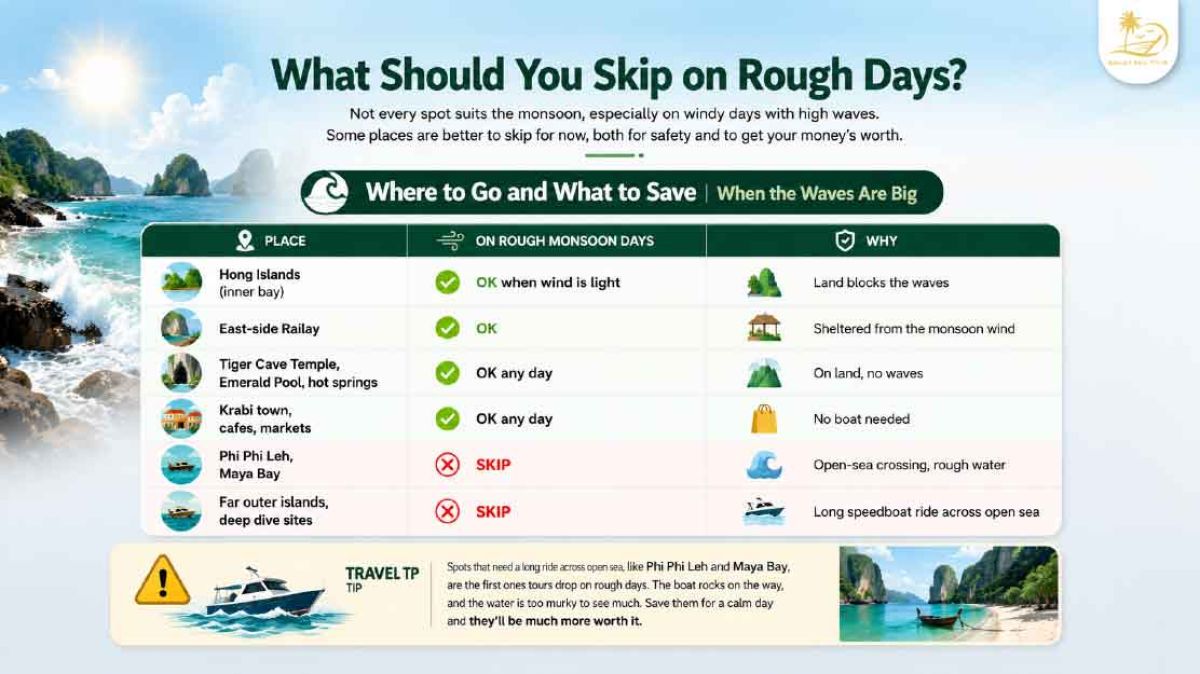
Where Can You Still Go in the Rainy Season?
Pick the right spots and monsoon Krabi is still a lot of fun. The simple rule: choose inner bays and places with land that blocks the waves, and save the outer islands for calm days.
Hong Islands is a group with inner bays and land all around, so it blocks waves well when the wind isn't too strong. The east side of Railay is sheltered from the monsoon wind, so you can still walk around and relax there even when the west side is rough.
On land there are plenty of choices with no waves to worry about: Tiger Cave Temple for a view over town, the Emerald Pool and hot springs for a natural soak, and Krabi town with its cafes and markets. Read Krabi rainy-season spots with clear water to pick spots where the water still works for a swim.
What Should You Skip on Rough Days?
Not every spot suits the monsoon, especially on windy days with high waves. Some places are better to skip for now, both for safety and to get your money's worth.
This table shows where to go and what to save when the waves are big.
| Place | On rough monsoon days | Why |
|---|---|---|
| Hong Islands (inner bay) | OK when wind is light | Land blocks the waves |
| East-side Railay | OK | Sheltered from the monsoon wind |
| Tiger Cave Temple, Emerald Pool, hot springs | OK any day | On land, no waves |
| Krabi town, cafes, markets | OK any day | No boat needed |
| Phi Phi Leh, Maya Bay | Skip | Open-sea crossing, rough water |
| Far outer islands, deep dive sites | Skip | Long speedboat ride across open sea |
Spots that need a long ride across open sea, like Phi Phi Leh and Maya Bay, are the first ones tours drop on rough days. The boat rocks on the way, and the water is too murky to see much. Save them for a calm day and they'll be much more worth it.
What Are the Good Things About Rainy-Season Krabi?
The monsoon isn't all bad. If you can handle some rain and waves, this time has upsides the dry season can't give you. First, way fewer crowds. Beaches and spots that are packed in the dry months feel empty, so photos look better and walking around is easier.
Second, lower prices for both rooms and tours. Many hotels drop their rates in the low season, so you get a nice room for less money. Third, the nature is super green. The forest and limestone hills are wet and look better than the dry, brown dry season. And the sky before the rain often has dramatic clouds that are great for photos.
Want to compare with the clearest water of the year? Read which month Krabi's sea is clearest to see which trips fit the rainy season and which ones to save for the dry months.
How Do You Make a Rainy-Season Trip Worth It?
Good planning makes a monsoon trip go much smoother. First, pick morning tours. Monsoon rain usually comes in the afternoon, so going early gives you a better shot at clear skies.
Second, book flexible or refundable trips. That way, if the sea closes, you can move or change your plan. Third, check the daily sea forecast before you head out. The Thai Meteorological Department posts the Andaman sea conditions every day, so you'll know ahead of time whether to go to the islands or switch to land spots.
Last, get travel insurance in case a flight is delayed or a trip is canceled by the weather. And don't forget a rain jacket and a dry bag for your phone and camera. Read the best months for the Andaman sea to compare the timing before you decide.
Make Rainy-Season Krabi Count With Guides Who Read the Sea
The key to a monsoon trip in Krabi is matching the island to the sea each day. People who live here do that better than an app alone. The Krabi guides at Railay Eco Tour read the wind and waves day by day, so they know when to take you out to Hong Islands and when to switch to Tiger Cave Temple and the Emerald Pool.
We won't push you out to sea on a rough day just to finish the program. Instead, we adjust the plan so every day is still safe and worth it. When the sea is closed, we always have a backup land spot. So a rainy-season trip doesn't go to waste.
When the sea is calm, check out the Hong Islands one-day tour, an inner bay that suits the monsoon. Or message our team to plan a trip that flexes with the weather on the days you're here.
Krabi in the Rainy Months? Don't Miss These Spots
Krabi's southwest monsoon runs May to October. Waves get bigger, it rains more often, and the water is murkier than the dry season. But you can still go to plenty of spots: Hong Islands on calm-wind days, the east side of Railay, and land spots like Tiger Cave Temple, the Emerald Pool, and the town.
On rough days, skip Phi Phi Leh, Maya Bay, and the far outer islands, and save them for a calm day. Plan your trip with morning tours, flexible bookings, a daily sea-forecast check, and travel insurance.
Want to compare the rainy season with the golden months? Read Krabi's golden season from January to April to pick the time that fits your trip and your budget.
Frequently Asked Questions
When is monsoon season in Krabi?
Krabi's southwest monsoon runs from May to October. The wind blows off the sea toward land, so waves get higher and it rains more often. September is usually the wettest and roughest month of this stretch.
Does it rain all day in Krabi during the rainy season?
Most days it doesn't rain all day. Many days it pours hard in the afternoon or evening, but only for a short time, then the sky clears. Mornings are usually the best part of the day, so morning tours catch clearer skies.
Can you still visit the islands during the monsoon?
Yes, on many days, especially inner bays like Hong Islands when the wind is light. Outer islands like Phi Phi Leh and Maya Bay may stop on rough days. Check the daily sea conditions and book trips you can move or get refunded.
Is a rainy-season trip to Krabi worth it?
It's worth it if you can handle some rain and waves. There are way fewer crowds, rooms and tours cost less, the hills are super green, and there are land spots to enjoy when the sea is closed. A guide who reads the wind and waves keeps each day worth it.
What should you pack for Krabi in the rainy season?
Bring a rain jacket and a dry bag for your phone and camera. Book morning tours, choose flexible or refundable trips, check the sea forecast from the Thai Meteorological Department, and get travel insurance in case a trip is delayed.
References
- Thai Meteorological Department: daily Andaman sea forecast
- Wikipedia: Monsoon: how monsoon winds work
- Tourism Authority of Thailand: Krabi: official Krabi travel info
- Bangkok Post: travel: southern Thailand travel news
Poda Island is a small island in Krabi province, south of Ao Nang — roughly 20 to 30 minutes by longtail boat or about 15 minutes by speedboat. What stands out is the fine white sand and the water, which stays shallow on a long gentle slope.
 Railay Eco
Pileh Lagoon sits on Phi Phi Leh in Krabi province — a bay almost completely ringed by tall limestone cliffs, with one narrow gap for boats to pass through. No swell reaches inside, so the water sits still, and the white sand floor below reflects the light back as emerald. Every trip to Phi Phi Leh stops here, because it is only minutes from Maya Bay.
Railay EcoKrabi Airport sits roughly 15 kilometres from Krabi town and 30 to 40 minutes by road from Ao Nang. To reach Ao Nang you can take the airport bus, a shared minivan, a taxi, or a private transfer booked in advance. Railay is a different matter: it is a peninsula no road reaches, so you take a vehicle to a pier and then a boat. The mistake people make most often is landing late and finding the last boats into Railay already finished for the day. This guide covers each transport option, journey times, rough costs, and how to handle a late arrival.
Railay EcoNopparat Thara Beach is in Krabi town district, immediately west of Ao Nang — five to ten minutes away on foot or by car. It runs for several kilometres, holds far fewer people than Ao Nang, and has the national park headquarters sitting right on the sand. The detail most visitors miss: at the lowest tides a sandbar emerges and you can walk out to the small island offshore without a boat. It also serves as a departure point for some island routes, so it works both as a place to rest and as a way out to sea. This guide covers how it differs from Ao Nang, how to get there, and when to go.
Railay EcoHong Island belongs to Krabi province and sits inside Than Bok Khorani National Park, north of Ao Nang — roughly 30 to 40 minutes by speedboat, or about an hour by longtail. What makes it different from the other Krabi islands is the lagoon in its middle: a pool of water almost entirely enclosed by tall limestone cliffs, with one narrow opening that small boats can slip through when the tide is high enough.
Railay EcoThe Emerald Pool sits in Khlong Thom district, Krabi province, roughly 60 to 70 kilometres from Krabi town — about an hour to an hour and a half by car. It is a natural pool clear enough to see the sand on the bottom, coloured green-blue by minerals in the groundwater and the light filtering through the canopy. From the car park you walk about 800 metres along a forest path. The path is mostly flat and comfortable even with children or older travellers. Two places most people pair with it on the same day: the Hot Springs nearby, and the Blue Pool a further walk in from the Emerald Pool itself. This guide covers the route, the entrance, the walking distances, and when the water is at its clearest.
Railay Eco