




Best Month for Clear Water in Krabi: When the Sea Looks Like Glass
The sea in Krabi is clearest from February to April. You can see 15-25 meters underwater. Skies are clear, waves are small, and snorkeling is amazing. From May to October, it's monsoon season — the water gets cloudy from sediment. Visibility drops to just 5-10 meters. If you want the clearest water, plan your trip in the dry months.
Why Water Clarity Matters
Clear water changes everything. Your underwater photos look way better. Snorkeling is more fun. Even just looking down from the boat is magical. The difference between 10 and 25 meters of visibility? Huge.
When the water is super clear, you can see coral and fish from the surface. You don't even need to dive. In the clearest months, you can see the bottom 15 meters down — clearly.
Pro divers measure clarity with a number called "visibility." That's the distance you can see things underwater. Higher number = clearer water. Read more about Krabi's seasons and best travel months for context.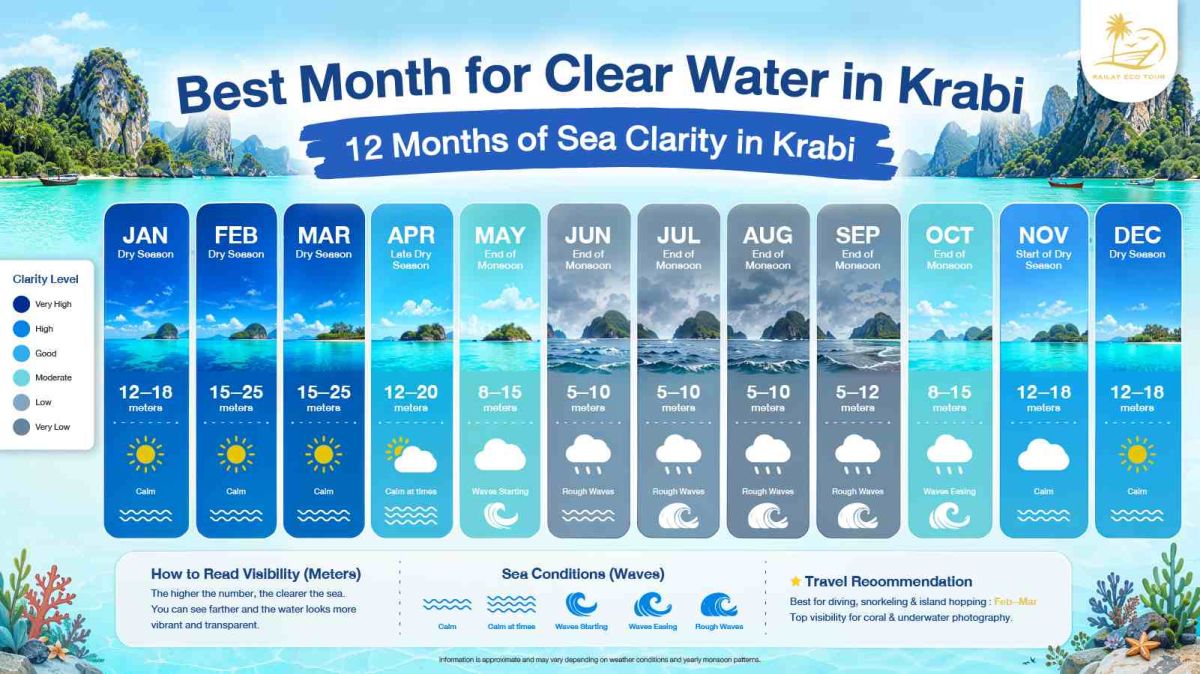
Krabi's Sea Through the Year
Here's a month-by-month breakdown:
| Month | Season | Visibility (m) | Waves | Clarity |
|---|---|---|---|---|
| Jan | Dry | 12-18 | Calm | Very clear |
| Feb | Dry | 15-25 | Calm | Best |
| Mar | Dry | 15-25 | Calm | Best |
| Apr | Late dry | 12-20 | Mostly calm | Clear |
| May | Early monsoon | 8-15 | Building waves | Medium |
| Jun | Monsoon | 5-10 | Strong waves | Low |
| Jul | Monsoon | 5-10 | Strong waves | Low |
| Aug | Monsoon | 5-10 | Strong waves | Lowest |
| Sep | Monsoon | 5-12 | Strong waves | Low |
| Oct | Late monsoon | 8-15 | Calming down | Medium |
| Nov | Early dry | 12-18 | Calm | Clear |
| Dec | Dry | 12-18 | Calm | Very clear |
You can see February and March are the absolute best.
Why Are Feb-March the Clearest?
A few reasons, actually:
Less Sediment in the Water
In dry season, there's not much rain. So less mud washes from rivers into the sea. The water stays clearer because nothing's floating around.
Calm Waves and Currents
Small waves mean the seafloor stays settled. No clouds of sand getting kicked up. Divers and snorkelers see coral and fish super clearly. Wave heights are just 0.5-1 meter — safe for swimming and boats.
Comfortable Water Temperature
Water hits 27-29°C (80-84°F). You can stay in the water for hours. No need for a wetsuit.
Better Sunlight Underwater
Clear skies mean strong sunlight reaches deep into the water. Your underwater photos pop with color. Coral and fish look detailed, not washed out.
The Clearest Spots in Krabi
Not every Krabi spot is the same. Even in the same month, some spots are clearer than others.
Poda Island
Poda has the clearest water of the 4 Islands. Visibility hits 12-20 meters in dry season. White sandy bottom reflects the light beautifully. The water looks emerald green. Perfect for photos and snorkeling.
Phi Phi Islands
Phi Phi Le and Maya Bay have Krabi's clearest water — period. Visibility reaches 15-25 meters in dry season. You can see coral and fish from the surface. But it gets crowded. Go before 9 AM if you want photos without people in them.
For the full story on Phi Phi, check out the Phi Phi Islands guide.
Hong Island and Phak Bia
Hong Island sits in a closed lagoon. So the water stays clear and calm year-round. Dry season visibility: 15-20 meters. Even in rainy season, it's still 8-12 meters. Way clearer than open spots.
Koh Rok (Inner and Outer)
Koh Rok is 2 hours from Krabi by speedboat. Visibility hits 20-30 meters. World-class diving. But you need a special diving tour to get there. Not for casual family trips.
Tips for Picking the Clearest Days
Even in clear months, some days are better than others.
Check for Rain the Night Before
If it rained hard last night, the water might be cloudy in the morning. River runoff brings mud. Check the weather forecast before you book a boat.
Time It With High Tide
At low tide, shallow areas near the shore can get murky. Sediment kicks up. Going at high tide gives you clearer water.
You can check tide tables online from the Hydrographic Department of the Royal Thai Navy.
Get to the Spot Before 10 AM
Early morning is the cleanest. Boats haven't churned up the water yet. Tourists are still at breakfast. The sediment hasn't been disturbed. Bonus: way fewer people for photos.
Avoid Days After Storms
Check the 5-7 day forecast. If a tropical storm or heavy rain is coming, the water stays cloudy for 2-3 days even after the rain stops.
Gear You Need for Clear Water Adventures
Basic snorkeling kit:
A snorkel set (mask, snorkel, fins). Rent for 100-200 baht per day. Or buy new for 600-1,500 baht.
A waterproof camera. GoPro or your phone in a waterproof case. Cases run 200-500 baht.
Reef-safe sunscreen — the kind that doesn't hurt coral. Many tour operators check your sunscreen before you board.
A quick-dry towel and waterproof bag for your phone and wallet.
Diving With Local Guides Who Know the Spots
Railay Eco Tour runs sea tours timed for the best season. Our guides know which spots stay clearest each day. We avoid crowded areas and rough water.
Our guides are certified divers. They take you to coral spots that are still healthy and water that's actually clear — not the famous spots packed with tourists.
For folks wanting healthy coral and clear water, check out the Hong Islands Full-Day Tour or Phi Phi Islands Full-Day Tour. Or contact us for diving advice based on the month you're visiting.
Quick Recap
Krabi's water is clearest from February to March. Visibility reaches 15-25 meters underwater. Perfect for snorkeling and photos.
The clearest spots? Phi Phi Le and Hong Island. Then Poda among the 4 Islands.
Plan your trip for February, March, or early April. Skip May-October if you want the clearest water. You'll have calm seas and crystal water.
Frequently Asked Questions
Should I skip Krabi during rainy season?
Not necessarily. Some spots stay clear in rainy season — like Hong Island (closed lagoon) and protected bays. Visibility drops to 8-12 meters versus 15-25 in dry season. Still totally fine for snorkeling, just not as wow.
Krabi vs Koh Samui — which has clearer water?
Krabi (Andaman side) is clearer than Samui (Gulf of Thailand side) by 5-10 meters on average. The Andaman is deeper with less sediment. But Krabi has a clear rainy season, while Samui gets rain spread across the whole year.
How does Krabi compare to the Maldives?
The Maldives wins by 5-10 meters of visibility. They're in the middle of the ocean — no continents nearby. But Krabi in its clearest months hits 25 meters. That's similar to Maldives in its average month. Krabi at its best is world-class.
Can I scuba dive in Krabi year-round?
Yes, but some spots close during monsoon season due to strong waves. Most Krabi dive schools adjust routes daily based on conditions. They pick spots in protected areas. So even in rainy season, you can dive — just at different spots.
What gear measures water clarity?
Divers use a "Secchi disk" — a black-and-white plate they lower into the water. Or just eyeball it. If you can see the sandy bottom 5 meters down clearly, it's good for snorkeling. Less than 5 meters? Scuba is fine but snorkeling won't show much.
References
- NOAA Coral Reef Watch: Weather and water conditions for coral reefs
- Wikipedia: The Andaman Sea
- Wikipedia: Phi Phi Islands
- Bangkok Post: Krabi travel feature
Krabi walking street runs in the old-town quarter of Krabi town, on weekend evenings only — not every night. Visitors staying in Ao Nang who drive in without checking the day regularly find an empty street. The draw is freshly cooked food at local prices that Krabi people actually eat: grilled seafood, regional sweets, fresh-pressed juices, plus handicraft stalls from people in the area.
 Railay Eco
Poda Island is a small island in Krabi province, south of Ao Nang — roughly 20 to 30 minutes by longtail boat or about 15 minutes by speedboat. What stands out is the fine white sand and the water, which stays shallow on a long gentle slope.
Railay EcoPileh Lagoon sits on Phi Phi Leh in Krabi province — a bay almost completely ringed by tall limestone cliffs, with one narrow gap for boats to pass through. No swell reaches inside, so the water sits still, and the white sand floor below reflects the light back as emerald. Every trip to Phi Phi Leh stops here, because it is only minutes from Maya Bay.
Railay EcoKrabi Airport sits roughly 15 kilometres from Krabi town and 30 to 40 minutes by road from Ao Nang. To reach Ao Nang you can take the airport bus, a shared minivan, a taxi, or a private transfer booked in advance. Railay is a different matter: it is a peninsula no road reaches, so you take a vehicle to a pier and then a boat. The mistake people make most often is landing late and finding the last boats into Railay already finished for the day. This guide covers each transport option, journey times, rough costs, and how to handle a late arrival.
Railay EcoNopparat Thara Beach is in Krabi town district, immediately west of Ao Nang — five to ten minutes away on foot or by car. It runs for several kilometres, holds far fewer people than Ao Nang, and has the national park headquarters sitting right on the sand. The detail most visitors miss: at the lowest tides a sandbar emerges and you can walk out to the small island offshore without a boat. It also serves as a departure point for some island routes, so it works both as a place to rest and as a way out to sea. This guide covers how it differs from Ao Nang, how to get there, and when to go.
Railay EcoHong Island belongs to Krabi province and sits inside Than Bok Khorani National Park, north of Ao Nang — roughly 30 to 40 minutes by speedboat, or about an hour by longtail. What makes it different from the other Krabi islands is the lagoon in its middle: a pool of water almost entirely enclosed by tall limestone cliffs, with one narrow opening that small boats can slip through when the tide is high enough.
Railay Eco