




Poda Island Krabi: Water So Shallow You Can Stand Across the Bay
 Railay Eco
Poda Island is a small island in Krabi province, south of Ao Nang — roughly 20 to 30 minutes by longtail boat or about 15 minutes by speedboat. What stands out is the fine white sand and the water, which stays shallow on a long gentle slope. You can wade out dozens of metres and it is still no deeper than an adult's waist, which makes it an easier island for small children than others in the same area. It sits on the half-day 4 Islands route out of Ao Nang, so getting there does not require chartering a boat. This guide covers how suitable it really is for children, how to get there, and the quietest hours.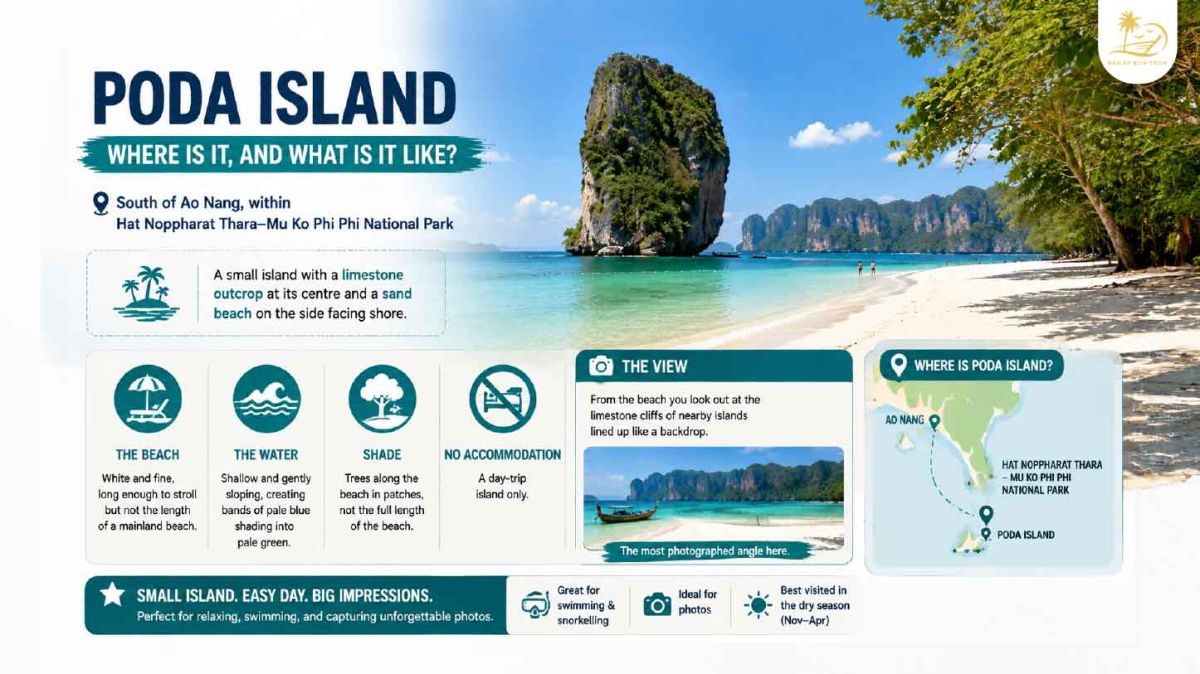
Where is Poda Island, and what is it like?
Poda Island lies within Hat Noppharat Thara–Mu Ko Phi Phi National Park, south of Ao Nang. It is a small island with a limestone outcrop at its centre and a sand beach on the side facing shore.
- The beach — white and fine, long enough to stroll but not the length of a mainland beach
- The water — shallow and gently sloping, which gives you bands of pale blue shading into pale green
- Shade — trees along the beach in patches, not the full length
- No accommodation — a day-trip island only
From the beach you look out at the limestone cliffs of nearby islands lined up like a backdrop. It is the most photographed angle here.
Is Poda Island good for small children?
This is the main reason families choose it, but there are things to know alongside.
What works for children
- Shallow, gently sloping water — children can stand, and adults can stay close the whole time
- A sand bottom — not rock or dead coral, so nobody cuts their feet wading in
- Gentle waves, because the island sits inside a bay with other islands blocking the swell further out
- A short boat ride from shore, so young children do not get bored or seasick
What to watch for
- Limited shade — bring a hat, a long-sleeved top, and a folding umbrella if you plan to stay a while
- No fresh water to rinse off at every spot — carry a bottle of plain water to rinse children after swimming
- Jellyfish in some parts of the year come close to shore. Ask your boatman before letting children in.
- Very low tide widens the beach but leaves the water so shallow you walk a long way before you can swim. Watch the tide timing.
If you want a whole day structured around children, the order of stops and the rest breaks matter as much as which island you pick. Our guide on family tours in Krabi covers how to build it.
How to get to Poda Island — is it on the 4 Islands tour?
It is on the 4 Islands route
Poda Island is one of the stops on the 4 Islands route from Ao Nang, which is how most people reach it — no separate charter needed.
- Half-day trips usually take in Poda, the sandbar, and one or two more stops
- Full-day trips give you longer on the beach and include lunch
- Both longtail and speedboat versions are available
The sandbar on the same route is where you can walk between islands at low tide. It is covered in our Talay Waek guide.
Chartering your own boat
- You can charter a longtail from Ao Nang straight to Poda
- You pick your own departure and return times, which suits families wanting flexibility
- Costs more than a group trip, but you are not on the group's clock
Journey times
- Longtail from Ao Nang, roughly 20 to 30 minutes
- Speedboat, roughly 15 minutes
- From Ao Nam Mao pier, broadly similar
Poda Island park fees
Poda Island is inside a national park, so there is a per-person entry fee.
- Thai and foreign rates differ, and there is a separate child rate
- The fee may not be included in your trip price — ask before booking
- Bring cash, since the collection point may not take other payment methods
Trips advertised well below market rate usually exclude the park fee and collect it on the day. Ask for the number before you pay.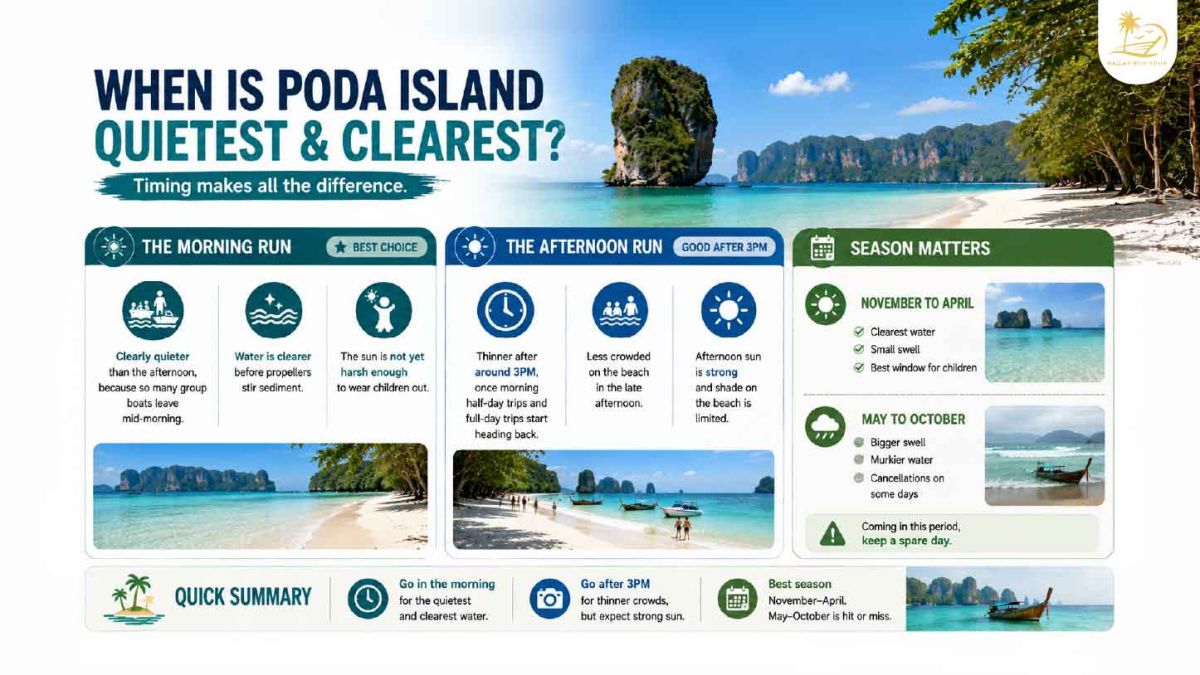
When is Poda Island quietest and clearest?
The morning run
Clearly quieter than the afternoon, because so many group boats leave mid-morning. The water is also clearer, before propellers stir sediment, and the sun is not yet harsh enough to wear children out.
The afternoon run
Thinner after around three, once the morning half-day trips and the full-day trips start heading back. But the afternoon sun is strong and shade on the beach is limited.
Season
- November to April — clearest water, small swell, the best window for children
- May to October — bigger swell and murkier water, with cancellations on some days. Coming in this period, keep a spare day.
What to bring to Poda Island
- Hat, light long-sleeved top, and a folding umbrella, since shade on the beach is patchy
- An extra bottle of plain water to rinse children after swimming
- Closed-heel shoes that can get wet for getting on and off the boat
- Reef-safe sunscreen, or a sun top instead
- A dry bag for your phone — boarding gets wet at some tides
- Snacks for children — the stalls on the island are limited and cost more than on shore
- Cash for the park fee if your trip excludes it
Take all your rubbish back with you; the island has no regular waste collection.
Want a Poda day with children that does not wear everyone out?
Sea trips with young children go wrong in two ways: leaving at the wrong hour and landing in full midday sun, and cramming in so many stops that the children are finished before you reach the one you actually came for.
Railay Eco Tour is a local boat team born and raised in Krabi. The route families pick most often is the morning half-day 4 Islands tour, which finishes before the midday sun. We time the run to reach Poda ahead of the big groups, cut the unnecessary stops when children are aboard, and pick the tide window where wading in is a few steps rather than a long walk. Our boats are inspected on a schedule and carry child-size life jackets. If you are planning the whole trip from scratch, see our complete Krabi travel guide, then tell us your children's ages and your dates and we will set the run to suit.
Frequently asked questions
Which province is Poda Island in?
Poda Island is in Krabi province, within Hat Noppharat Thara–Mu Ko Phi Phi National Park, south of Ao Nang. It is roughly 20 to 30 minutes by longtail boat or about 15 minutes by speedboat.
Is Poda Island good for small children?
Yes. The water is shallow on a long gentle slope, the bottom is sand rather than rock, waves are gentle because other islands block the swell, and the boat ride is short. Shade is limited though, so bring a hat, a sun top, and water to rinse off.
Is Poda Island part of the 4 Islands tour?
Yes. Poda is one of the stops on the 4 Islands route from Ao Nang, so you can reach it without a separate charter. Half-day and full-day versions both exist, or you can charter a longtail directly.
Is there a park fee for Poda Island?
Yes, since it sits inside a national park. Thai and foreign rates differ and there is a separate child rate. The fee may not be in your trip price, so confirm before booking and bring cash.
What time is Poda Island quietest?
The morning, before the group boats leave mid-morning — clearer water and a gentler sun. The other window is after around three, when morning trips head back, though the afternoon sun is strong and shade is patchy.
References
- Wikipedia: Hat Noppharat Thara–Mu Ko Phi Phi National Park: park boundaries and the islands it covers
- Wikipedia: Krabi Province: geography and seasons
- Department of Tourism, Thailand: tour operator standards
Poda Island is a small island in Krabi province, south of Ao Nang — roughly 20 to 30 minutes by longtail boat or about 15 minutes by speedboat. What stands out is the fine white sand and the water, which stays shallow on a long gentle slope.
 Railay Eco
Pileh Lagoon sits on Phi Phi Leh in Krabi province — a bay almost completely ringed by tall limestone cliffs, with one narrow gap for boats to pass through. No swell reaches inside, so the water sits still, and the white sand floor below reflects the light back as emerald. Every trip to Phi Phi Leh stops here, because it is only minutes from Maya Bay.
Railay EcoKrabi Airport sits roughly 15 kilometres from Krabi town and 30 to 40 minutes by road from Ao Nang. To reach Ao Nang you can take the airport bus, a shared minivan, a taxi, or a private transfer booked in advance. Railay is a different matter: it is a peninsula no road reaches, so you take a vehicle to a pier and then a boat. The mistake people make most often is landing late and finding the last boats into Railay already finished for the day. This guide covers each transport option, journey times, rough costs, and how to handle a late arrival.
Railay EcoNopparat Thara Beach is in Krabi town district, immediately west of Ao Nang — five to ten minutes away on foot or by car. It runs for several kilometres, holds far fewer people than Ao Nang, and has the national park headquarters sitting right on the sand. The detail most visitors miss: at the lowest tides a sandbar emerges and you can walk out to the small island offshore without a boat. It also serves as a departure point for some island routes, so it works both as a place to rest and as a way out to sea. This guide covers how it differs from Ao Nang, how to get there, and when to go.
Railay EcoHong Island belongs to Krabi province and sits inside Than Bok Khorani National Park, north of Ao Nang — roughly 30 to 40 minutes by speedboat, or about an hour by longtail. What makes it different from the other Krabi islands is the lagoon in its middle: a pool of water almost entirely enclosed by tall limestone cliffs, with one narrow opening that small boats can slip through when the tide is high enough.
Railay EcoThe Emerald Pool sits in Khlong Thom district, Krabi province, roughly 60 to 70 kilometres from Krabi town — about an hour to an hour and a half by car. It is a natural pool clear enough to see the sand on the bottom, coloured green-blue by minerals in the groundwater and the light filtering through the canopy. From the car park you walk about 800 metres along a forest path. The path is mostly flat and comfortable even with children or older travellers. Two places most people pair with it on the same day: the Hot Springs nearby, and the Blue Pool a further walk in from the Emerald Pool itself. This guide covers the route, the entrance, the walking distances, and when the water is at its clearest.
Railay Eco