




5 Krabi Spots With Clear Water Even in Rainy Season
Krabi rainy season clear water sounds impossible to most travelers. But it isn't. The open sea gets choppy when monsoon winds arrive, yet Krabi has many bays and islands that block the wind. The water there stays calm and clear all year. This guide shows you 5 spots that stay snorkel-friendly during the rains, plus the best months to visit each one.
How Can Krabi Water Stay Clear Even in the Rain?
Krabi sits on the Andaman coast. From May to October, southwest monsoon winds push waves and stir up sand in the open sea. But Krabi has a special shape. Tall limestone cliffs ring many of its bays. These cliffs block the wind. So the water inside stays still and clear, even when waves crash outside.
Three things make a bay clear in the rainy season. First, the bay faces east or north so it hides from the southwest wind. Second, the water is shallow with a sandy bottom, so light bounces back up. Third, the bay sits far from river mouths, so muddy fresh water doesn't mix in.
Want to know which months have the clearest water overall? Read the best month for clear water in Krabi to see the full month-by-month table.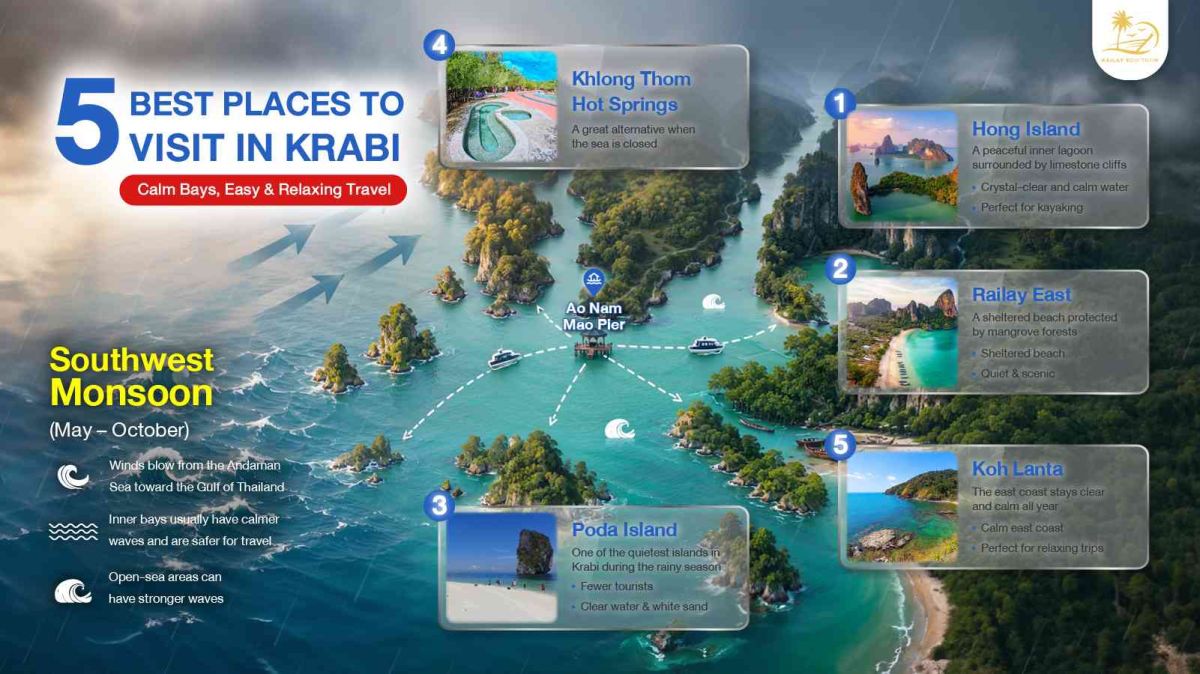
Spot 1: Hong Island, the Bay Inside a Ring of Cliffs
Hong Island is the top pick for a Krabi monsoon snorkel trip. The inner bay looks like a room. Walls of limestone cliffs surround it. The only way in is a narrow gap. Waves from the open sea can't get through that gap. So the water stays glass-clear.
The bay is 1.5 to 3 meters deep. The bottom is fine white sand. You can see small fish swim and even shells lying on the sand. It's perfect for kids and weak swimmers.
How to Get There
From Ao Nam Mao Pier or Ao Nang Pier, longtail boats take 25 to 30 minutes. Speedboats take 15 minutes. A private boat costs 2,500 to 3,500 baht. A half-day tour costs 800 to 1,200 baht per person and includes the boat, a guide, and snacks.
Best Months
June to August is the sweet spot. The outside waves are not too strong yet. Boats run almost every day. Skip late September. That's when tropical storms hit most often.
Spot 2: Railay East, the Beach Mangroves Protect
Railay East is another spot where you can find clear water rainy Krabi style. The beach faces east. That means it hides from the southwest wind. Mangroves at the back of the beach also help break the waves before they reach shore.
The best part about Railay East? You can get there all year. Longtail boats from Ao Nang run every day, even when the open sea is rough. The ride takes 15 minutes. The fare is 100 to 150 baht per person.
The beach has small restaurants, mid-range hotels, and kayak rentals. Kayaks cost 200 to 300 baht per hour. Paddle into the mangroves in the morning at low tide to spot monkeys and birds.
What to Do in the Rainy Season
- Kayak through the mangroves at low tide
- Walk over to Railay West Beach in 5 minutes
- Try rock climbing at Tonsai with an instructor (800 to 1,500 baht per session)
- Snorkel at Phra Nang Cave Beach where the sand is white and the water is clear
Spot 3: Koh Poda, the Quietest Spot in Rainy Season
Koh Poda is part of the famous 4-Islands tour. But in the rainy season, the crowds drop a lot. Most people think they can't go. The truth is the inner bay of Koh Poda faces northeast. It blocks the southwest monsoon well. The water stays clear on days without storms.
Koh Poda has a 700-meter strip of white sand. The grains are as fine as flour. The water is shallow, only 0.5 to 2 meters deep, for a long way out. Kids can play safely. There's also a coral patch at the end of the beach for easy snorkeling.
Getting There in the Rains
In the rainy season, 4-Islands tour boats still run most days. Just check the weather in the morning. A half-day tour costs 800 to 1,200 baht per person. A private boat costs 2,500 to 3,500 baht.
On rough days, the boats switch routes. They visit 2 or 3 islands instead of 4. Ask the tour operator before you pay. If you want to see all 4 islands for sure, pick a day when the Surface Wave Index is below 1.5 meters.
Spot 4: Klong Thom Hot Springs, the Backup When the Sea Closes
On days when the sea is too rough and boats stop, Klong Thom Hot Springs is a great Plan B. It's 70 kilometers from Krabi town, about an hour and 15 minutes by car.
The springs are natural pools fed by warm water, 35 to 40 degrees Celsius. The water flows through limestone, so it's crystal clear. You can lie in the pools and relax. Rain days actually feel nice here. The forest cover keeps things dry, and the air smells fresh.
Entry costs 90 baht for Thais and 200 baht for tourists. Open from 8:00 to 18:00. Nearby, you'll find Krabi Hot Spring Waterfall and Khao Pra Bang Khram National Park. Plan 3 to 4 hours total.
Why It Works in the Rains
Everything is under tree cover. Light rain doesn't stop your day. Compare that to the sea, where heavy rain forces an early return. The cost is also half of a sea tour.
Spot 5: Koh Lanta, the East Side Stays Clear All Year
Koh Lanta sits south of Krabi. The drive plus ferry takes 2 to 2.5 hours from town. The island's secret is its east side. That side faces the inner sea. The monsoon wind can't reach it.
Three beaches stand out in the rainy season. Klong Jark Beach at the south is clear, quiet, and barely known. Klong Khong Beach in the middle has shallow water, good for families. Bamboo Bay at the far end feels remote and peaceful.
Where to Stay
Rainy season prices drop 40 to 60 percent off high season. Beachfront bungalows start at 800 to 1,500 baht per night. Mid-range resorts cost 1,800 to 3,500 baht. Top-tier rooms run 5,000 to 8,000 baht.
Stay 2 to 3 nights to explore the bays and meet local people. Rent a scooter for 250 to 350 baht per day. You can ride around the whole island in 2 to 3 hours.
Compare the 5 Spots at a Glance
| Spot | Distance | Cost per Person | Best For |
|---|---|---|---|
| Hong Island | 1 hr by boat | 800-1,200 THB | Families, seniors |
| Railay East | 30 min | 600-1,000 THB | Climbers, couples |
| Koh Poda | 45 min by boat | 800-1,200 THB | Families, snorkelers |
| Klong Thom Hot Springs | 1 hr 15 min | 300-500 THB | Heavy rain days |
| Koh Lanta | 2-2.5 hrs | 2,500-5,000 THB/2 days | Couples, honeymoon |
What to Pack for Rainy Season Krabi
Check the weather 1 to 2 days ahead on the Thai Meteorological Department site. Look at the Surface Wave Index and wind direction. On days with southwest winds above 25 km/h, boats often cancel. Pick a day below 15 km/h for the safest trip.
Pack a foldable rain poncho, a microfiber towel that dries fast, and a waterproof phone bag. For the full packing list, read our complete Krabi travel guide.
Book hotels at least 3 to 5 days ahead. Rainy season has fewer tourists, but some hotels close for maintenance. This is most common in September. Check reviews to make sure your hotel is open in the month you visit.
Want to compare seasons before you pick a month? Read when is the best time to visit Krabi for the pros and cons of each season.
Tour Krabi With Guides Who Know This Coast Inside Out
At Railay Eco Tour, we run sea tours all 12 months of the year. Our guides know which spots are clear in each month. They know wind directions. They know tide times. And they know which routes other tour operators cancel on rough days.
Our full-day Hong Islands tour is our top pick for rainy-season travelers. Hong Island works almost every day thanks to its sheltered inner bay. We use a Luxury Speedboat that's bigger and steadier than normal boats. It handles waves much better.
Got young kids or older travelers? Reach out to our team for a private trip we can adjust on the fly. If the day turns ugly, we switch you to hot springs or Tiger Cave Temple at no extra cost.
Rainy Season in Krabi — Don't Miss These 5 Spots
So, where to go in Krabi during the rains? Pick from these 5 spots. Hong Island is the best because its inner bay sits inside a wall of cliffs. Railay East stays open all year and offers more than just swimming. Koh Poda gets quiet and peaceful. Klong Thom Hot Springs saves the day when the sea is rough. And Koh Lanta is perfect for a slower 2 or 3 night break.
Clear water in the rainy season is real if you know where to look and which days to pick. Hotels and tours cost 30 to 50 percent less than high season. There are far fewer tourists. Just pack a poncho, check the forecast, and book with operators who actually know the sea.
Frequently Asked Questions
Which rainy season month has the clearest water in Krabi?
June through early August has the best water. Monsoon winds haven't hit full strength yet. You'll get 5 to 7 dry days each month with bright skies. Avoid September and early October, when tropical storms are most common.
Do sea tours in Krabi cancel often during the rainy season?
It depends on the route. Hong Island and Railay tours cancel only 10 to 15 percent of days. Phi Phi and 4-Islands tours cancel more, around 30 to 40 percent. On rough days, good operators offer a full refund or move your tour to another day.
How much cheaper are hotels in Krabi during the rains?
Hotels cost 30 to 50 percent less than high season. Some 5-star places drop their rates by 60 percent. A beach bungalow that costs 2,500 baht in high season drops to 1,200 to 1,500 baht in the rains. Compare to December and January for the biggest savings.
Can you still see coral when snorkeling in the rainy season?
Yes, in sheltered inner bays. Spots like Hong Island, Koh Poda, and Koh Kai stay clear with 5 to 10 meter visibility, close to high-season levels. Open-sea spots like Phi Phi and Koh Rok drop to 2 to 5 meters. Skip snorkeling on rough wave days.
Is rainy season Krabi safe for sea trips?
Yes, if you pick the right operator. The boat must meet safety standards and the guide must be a pro. Operators should check the weather before leaving. Life jackets stay on the whole trip. Routes should hide from the monsoon. Avoid small longtail boats on days with 2-meter waves or more. Watch for warning flags at the pier. A red flag means the sea is closed.
References
Krabi walking street runs in the old-town quarter of Krabi town, on weekend evenings only — not every night. Visitors staying in Ao Nang who drive in without checking the day regularly find an empty street. The draw is freshly cooked food at local prices that Krabi people actually eat: grilled seafood, regional sweets, fresh-pressed juices, plus handicraft stalls from people in the area.
 Railay Eco
Poda Island is a small island in Krabi province, south of Ao Nang — roughly 20 to 30 minutes by longtail boat or about 15 minutes by speedboat. What stands out is the fine white sand and the water, which stays shallow on a long gentle slope.
Railay EcoPileh Lagoon sits on Phi Phi Leh in Krabi province — a bay almost completely ringed by tall limestone cliffs, with one narrow gap for boats to pass through. No swell reaches inside, so the water sits still, and the white sand floor below reflects the light back as emerald. Every trip to Phi Phi Leh stops here, because it is only minutes from Maya Bay.
Railay EcoKrabi Airport sits roughly 15 kilometres from Krabi town and 30 to 40 minutes by road from Ao Nang. To reach Ao Nang you can take the airport bus, a shared minivan, a taxi, or a private transfer booked in advance. Railay is a different matter: it is a peninsula no road reaches, so you take a vehicle to a pier and then a boat. The mistake people make most often is landing late and finding the last boats into Railay already finished for the day. This guide covers each transport option, journey times, rough costs, and how to handle a late arrival.
Railay EcoNopparat Thara Beach is in Krabi town district, immediately west of Ao Nang — five to ten minutes away on foot or by car. It runs for several kilometres, holds far fewer people than Ao Nang, and has the national park headquarters sitting right on the sand. The detail most visitors miss: at the lowest tides a sandbar emerges and you can walk out to the small island offshore without a boat. It also serves as a departure point for some island routes, so it works both as a place to rest and as a way out to sea. This guide covers how it differs from Ao Nang, how to get there, and when to go.
Railay EcoHong Island belongs to Krabi province and sits inside Than Bok Khorani National Park, north of Ao Nang — roughly 30 to 40 minutes by speedboat, or about an hour by longtail. What makes it different from the other Krabi islands is the lagoon in its middle: a pool of water almost entirely enclosed by tall limestone cliffs, with one narrow opening that small boats can slip through when the tide is high enough.
Railay Eco