




What a Local Krabi Guide Shows You That Regular Tours Miss
 railay team
A local Krabi guide is someone born and raised in Krabi Province. They speak the local dialect, know hidden restaurants not in reviews, understand the culture and history, and know secret photo spots regular tourists can't find. They're different from guides who aren't from Krabi who learn from guidebooks, not real life. This guide covers the 6 things local guides do better, how to check if a guide is really local, and why picking a local guide makes your trip deeper.
How Are Local Guides Different from Other Guides?
A local Krabi guide is born in Krabi, went to school in Krabi, and lives in Krabi year-round. They speak southern Thai dialect like a native. They use local words. They know people in every community.
A guide sent from Bangkok or other regions works in Krabi only during high season (4 to 6 months per year). They learn from guidebooks and company manuals. Their knowledge is broad but shallow.
The result: local guides tell stories from the insider's view. non-local guides tell stories from the outsider's view they studied. This difference matters for travelers who want to really understand the culture and lifestyle.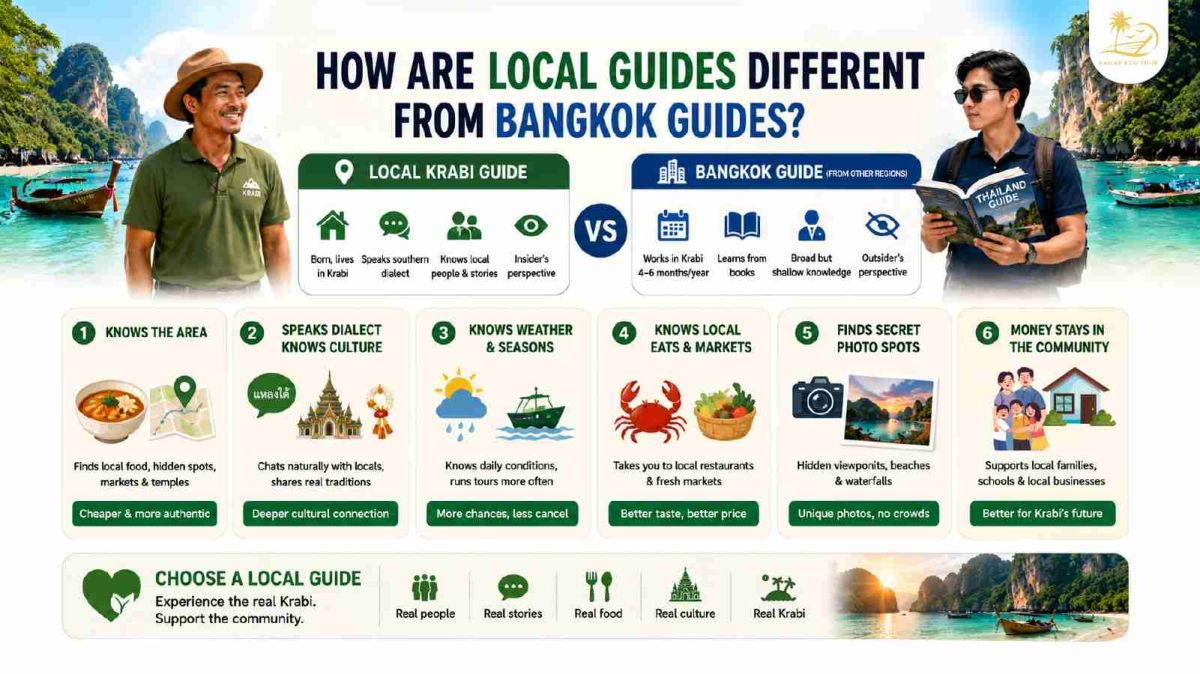
Thing 1: They Know the Area Down to the Side Street
Local guides know which alley in Krabi town has real southern food (not tourist-style food). They know what time the tide rises and falls at each beach. They know which days the night market is open. They know which temple has a famous monk.
non-local guides know only the main tourist spots from the map: night market, Wat Tham Suea (Tiger Cave Temple), viewpoints, and Ao Nang Beach. They don't know the hidden alleys, local shops, or markets where Krabi people go.
For families who want to try real southern food like gaeng tai pla (fish curry), khanom jeen nam ya (rice noodles with curry sauce), or khao yam (southern salad rice), local guides bring you to places Krabi people eat. Prices are 80 to 150 baht per person. That's much cheaper than tourist restaurants at 250 to 400 baht per person, and the flavor is real.
Thing 2: They Speak the Dialect and Know the Culture
Local guides speak southern Thai dialect fluently. They use words like "roi" (delicious), "yae" (yes), and "keep jang" (super fun). They know what each word means in different contexts. So they can chat with villagers naturally.
non-local guides barely speak southern dialect. They speak standard Bangkok Thai. Villagers treat them like tourists and don't open up. They won't share deep stories.
The cultural knowledge is different too. Local guides know which month each temple holds a merit-making festival. They know the rituals for worshipping the Phra Nang goddess. They know stories about Krabi's old rulers. And they know why Poda Island is sacred to fishermen.
Thing 3: They Know the Weather and Seasons Better
Local guides know that September (the rainy month) has 5 to 7 days of clear weather between rain spells, perfect for boating. They know that February brings north winds that make the water shallow and the waves small. And they know that early May the winds change, so the open sea starts to get rough.
non-local guides know what the books say: this month is dry season, this month is rainy season. But they don't know day-by-day details.
A local-led tour can run boats more often in rainy season than a non-local-guide tour. That's because local guides know which days the waves are small enough. They don't cancel trips too early.
Thing 4: They Know Local Restaurants and Fresh Markets
Local guides take guests to family-run restaurants Krabi people have eaten at for years. Like P'Nit's khanom jeen shop. The morning market with crab at 120 to 180 baht per kilogram. And a real fish ball noodle shop Krabi people must eat at.
non-local guides take guests to places in online reviews. Prices are 30 to 50 percent higher. Flavors aren't real because they're adjusted for foreign tourists. And you waste 30 to 60 minutes waiting in line.
The fresh markets local guides bring you to are the cultural morning market, the south Prachuap evening market, and the Saturday-Sunday market in Krabi town. non-local guides only know the Ao Nang night market that tourists pack.
Thing 5: They Know Secret Photo Spots Not on the Map
Local guides know a small mountain sunset viewpoint near Krabi town with no tourists. You see the limestone cliffs cutting through the water as a full panoramic view. They know rainbow-colored shell collection spots at tiny beaches no one knows about. And they know waterfalls in forests just 500 meters off the main road.
non-local guides know only the popular Instagram-famous photo spots. Ao Nang Viewpoint. Noppharat Thara natural rock bridge. And Phra Nang Cave Beach. All of which are crowded and hard to photograph at.
For couples who want unique engagement or pre-wedding photos, contact a local guide. You'll get shots you can't get anywhere else.
Thing 6: Money Stays in the Community
Picking a local guide means choosing to send your money back to a Krabi family. Local guides spend their pay in Krabi. They send their kids to Krabi schools. They buy from local shops.
non-local guides take most of their pay back to use in Bangkok. So Krabi's economy benefits less. Even though the province takes most of the tourism impact.
Travelers who care about sustainable travel pick local guides as a basic step. Read our eco tour Krabi guide for the 7 rules of community-friendly travel.
Limits of Local Guides
Some local guides speak limited English. Their knowledge of world history and global geography may be less than university-trained guides. They may not be used to handling foreign guests with special needs.
The fix is to pick a tour company that trains its local guides. They send them for extra English and global history classes. So you get both deep local knowledge and international professionalism.
Or pick a tour with 2 guides. A local guide tells stories and shows hidden spots. A fluent English guide translates for foreign guests. It costs 20 to 30 percent more but you get both sides.
How to Check If a Guide Is Really Krabi-Born
Ask where they went to school. Local guides went to old Krabi schools like Amat Phanichanukoon School, Nuea Khlong School, or Rajabhat Phuket University. Not a school in Bangkok.
Ask where their family lives. Local guides have parents and relatives in Krabi. Not a family in Bangkok with the guide here on temporary work.
Ask them to speak southern dialect for 2 or 3 sentences. Local guides speak it fluently. non-local guides only know a few easy words.
Ask for their guide license. Check the address on the license. Local guides have an address in Krabi. non-local guides have an address in Bangkok.
Tours Designed for You by Krabi Locals
Railay Eco Tour has a team of 25 guides. 95 percent are Krabi locals who grew up here. All trained by the Department of Tourism and fluent in English. Combining local knowledge with international standards in one person.
Our guides have access to local restaurants, fresh markets, hidden photo spots, and cultural stories non-local guides don't know. Your trip gets a deeper experience.
Our 4 islands half-day tour uses a Krabi-born guide who stops at a local fried-fish shop along the way. The tour costs 1,200 to 1,500 baht per person including lunch at a Krabi family restaurant.
For families who want a deeper day trip without other tourists, contact our team for a private Krabi-local guide. Prices start at 2,500 baht per half-day including car, guide, and group-specific advice.
Local Krabi Guides: Don't Miss This If You Want a Real Trip
Local Krabi guides know 6 things non-local guides don't. From street-level area knowledge, to dialect and culture, to accurate weather, to local restaurants, to secret photo spots, to keeping money in the community.
Tours led by local guides give a deeper experience. You eat real food. You visit places other tourists don't. And you help Krabi's economy grow sustainably.
Foreign travelers worried about English: pick a company that trains its local guides to speak English. You don't lose the local advantage just for language. For Krabi trip plans that include meeting local communities, read our complete Krabi travel guide for 3 to 5-day plans.
Frequently Asked Questions
Are local Krabi guides more expensive than other guides?
They cost the same or 5 to 15 percent less. Local guides have no travel or hotel costs like guides from Bangkok do. Private guide rates are 1,500 to 2,500 baht per day. Same as regular guides but you get a deeper experience.
Do local Krabi guides speak English?
Depends on the company. Big companies with international standards train local guides to be fluent. 90 percent of the team speaks English. Small companies may have local guides with weak English. Check before booking.
Who suits a local Krabi guide?
Thai families who want to know Krabi deeply. Couples who want unique photos and experiences. Foreign travelers interested in Thai culture. And travelers who care about sustainable tourism.
Where do I book an independent local Krabi guide?
Book through guide-listing websites like GoWithGuide or Showaround that have independent Krabi guides. Prices start at 800 to 1,500 baht per half-day. Check reviews before hiring. Watch out for insurance which may not cover you.
How far ahead should I book a local Krabi guide?
Book 1 to 3 weeks ahead during high season (November to April). Quality guides fill fast. In rainy season (May to October), 3 to 7 days ahead is fine. On Songkran and New Year, book 4 to 6 weeks ahead.
References
Krabi walking street runs in the old-town quarter of Krabi town, on weekend evenings only — not every night. Visitors staying in Ao Nang who drive in without checking the day regularly find an empty street. The draw is freshly cooked food at local prices that Krabi people actually eat: grilled seafood, regional sweets, fresh-pressed juices, plus handicraft stalls from people in the area.
 Railay Eco
Poda Island is a small island in Krabi province, south of Ao Nang — roughly 20 to 30 minutes by longtail boat or about 15 minutes by speedboat. What stands out is the fine white sand and the water, which stays shallow on a long gentle slope.
Railay EcoPileh Lagoon sits on Phi Phi Leh in Krabi province — a bay almost completely ringed by tall limestone cliffs, with one narrow gap for boats to pass through. No swell reaches inside, so the water sits still, and the white sand floor below reflects the light back as emerald. Every trip to Phi Phi Leh stops here, because it is only minutes from Maya Bay.
Railay EcoKrabi Airport sits roughly 15 kilometres from Krabi town and 30 to 40 minutes by road from Ao Nang. To reach Ao Nang you can take the airport bus, a shared minivan, a taxi, or a private transfer booked in advance. Railay is a different matter: it is a peninsula no road reaches, so you take a vehicle to a pier and then a boat. The mistake people make most often is landing late and finding the last boats into Railay already finished for the day. This guide covers each transport option, journey times, rough costs, and how to handle a late arrival.
Railay EcoNopparat Thara Beach is in Krabi town district, immediately west of Ao Nang — five to ten minutes away on foot or by car. It runs for several kilometres, holds far fewer people than Ao Nang, and has the national park headquarters sitting right on the sand. The detail most visitors miss: at the lowest tides a sandbar emerges and you can walk out to the small island offshore without a boat. It also serves as a departure point for some island routes, so it works both as a place to rest and as a way out to sea. This guide covers how it differs from Ao Nang, how to get there, and when to go.
Railay EcoHong Island belongs to Krabi province and sits inside Than Bok Khorani National Park, north of Ao Nang — roughly 30 to 40 minutes by speedboat, or about an hour by longtail. What makes it different from the other Krabi islands is the lagoon in its middle: a pool of water almost entirely enclosed by tall limestone cliffs, with one narrow opening that small boats can slip through when the tide is high enough.
Railay Eco