




Krabi Elephant Camps: Which Kind Is Actually Fun to Visit
 Railay Eco
Krabi has 3 kinds of elephant camp, and they give you completely different days out. Feeding-and-bathing camps let you touch the animals and get soaked, which is the closest contact you can get. Walk-and-observe camps let you watch elephants feeding in real forest while you walk hill trails with streams running through them, which is the pick if you want nature rather than contact. Riding camps are the format most international visitors have stopped booking and most large travel companies have stopped selling. Whichever you choose, the morning session is the one worth taking: it is cooler, the animals move and play in the water far more than in the afternoon, the photos come out better, and you still have the afternoon free for another inland stop. This guide compares what you actually do at each type, which one is worth the half day it costs you, and how to pick a camp that gives you a good trip.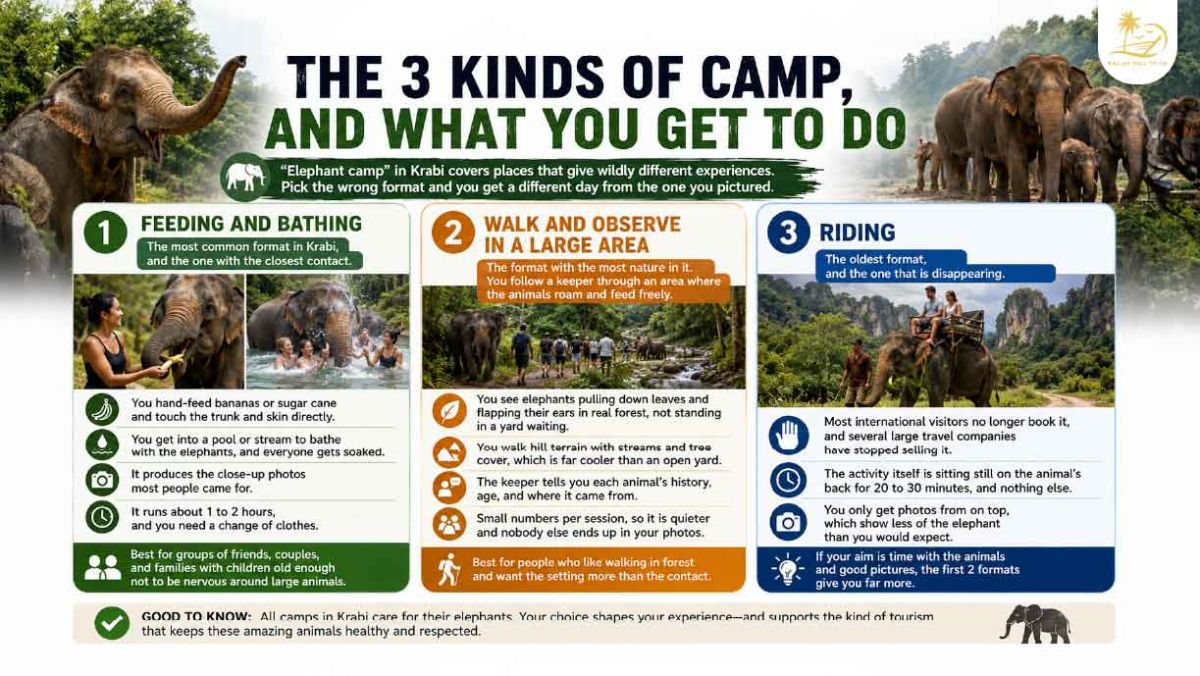
The 3 kinds of camp, and what you get to do
"Elephant camp" in Krabi covers places that give wildly different experiences. Pick the wrong format and you get a different day from the one you pictured.
Feeding and bathing
The most common format in Krabi, and the one with the closest contact.
- You hand-feed bananas or sugar cane and touch the trunk and skin directly.
- You get into a pool or stream to bathe with the elephants, and everyone gets soaked.
- It produces the close-up photos most people came for.
- It runs about 1 to 2 hours, and you need a change of clothes.
Best for groups of friends, couples, and families with children old enough not to be nervous around large animals.
Walk and observe in a large area
The format with the most nature in it. You follow a keeper through an area where the animals roam and feed freely.
- You see elephants pulling down leaves and flapping their ears in real forest, not standing in a yard waiting.
- You walk hill terrain with streams and tree cover, which is far cooler than an open yard.
- The keeper tells you each animal's history, age, and where it came from.
- Small numbers per session, so it is quieter and nobody else ends up in your photos.
Best for people who like walking in forest and want the setting more than the contact.
Riding
The oldest format, and the one that is disappearing. The elephant carries a seat and walks a set route.
- Most international visitors no longer book it, and several large travel companies have stopped selling it.
- The activity itself is sitting still on the animal's back for 20 to 30 minutes, and nothing else.
- You only get photos from on top, which show less of the elephant than you would expect.
If your aim is time with the animals and good pictures, the first 2 formats give you far more.
Which format is worth the half day?
Most camps are 30 to 50 minutes from Ao Nang, so once you add the drive both ways this trip always costs you half a day. The question is not which is cheapest, but what that half day gives you back.
| What you want | Pick | Time at the camp |
|---|---|---|
| Close contact, close-up photos, getting soaked | Feeding and bathing | About 1 to 2 hours |
| Forest, streams, quiet, elephants behaving naturally | Walk and observe | About 1.5 to 2.5 hours |
| Several stops in one day | Any morning session, then continue inland | About 1 to 2 hours |
The morning session beats the afternoon in almost every case: cooler air, more movement and water play, better light for photos, and an afternoon still free. The inland stops people usually add on the same day are covered in our guide to things to do in Krabi that aren't the beach.
There is one more reason this trip earns its place: it runs in any weather. On a day when the swell is too big for boats to leave, the elephant camps open as normal, which makes this the best backup plan you can hold for a blown-out sea day.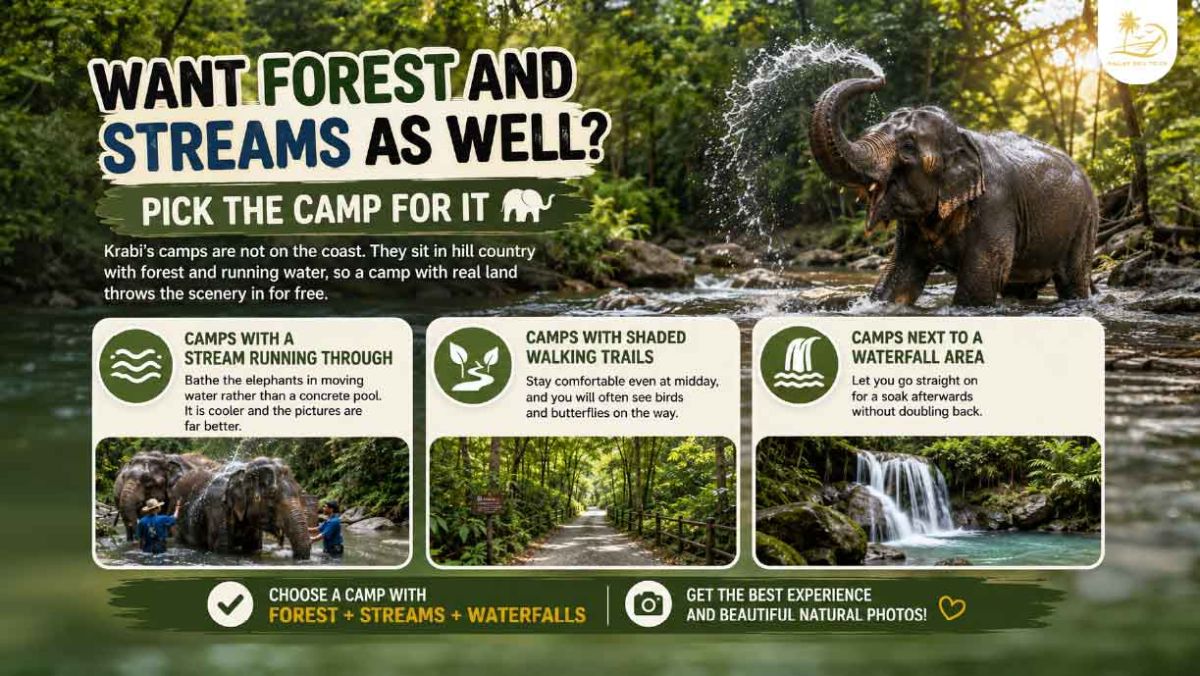
Want forest and streams as well? Pick the camp for it
Krabi's camps are not on the coast. They sit in hill country with forest and running water, so a camp with real land throws the scenery in for free.
- Camps with a stream running through bathe the elephants in moving water rather than a concrete pool. It is cooler and the pictures are far better.
- Camps with shaded walking trails stay comfortable even at midday, and you will often see birds and butterflies on the way.
- Camps next to a waterfall area let you go straight on for a soak afterwards without doubling back.
If you want to know what counts as genuinely low-impact travel here, compare our guides to eco tours in Krabi and sustainable tourism in Krabi.
Why a well-run camp is simply a better visit
This is not only about the animals. It lands directly on your day. A camp that overfills its sessions gives you tired elephants standing still, long queues, little time each, and other visitors in every frame. A camp that caps its sessions gives you animals that still move and play, and real time with them.
What you see on site tells you more than the marketing does.
Signs the visit will be good
- Real space with genuine shade, not a narrow concrete yard, so the animals walk for you and your photos have forest behind them.
- A cap on visitors per session, which means longer with the elephants and no fighting for an angle.
- No performances, no painting, football, or standing on 2 legs, because tricks eat the time you should be spending with the animals.
- Clean water and piles of rough feed such as grass or leaves, meaning the elephants are not just waiting on visitor bananas.
- Keepers who answer questions about each animal's age, origin, and how many sessions it does a day.
Signs to avoid
- An elephant swaying repeatedly on the spot, a stress behaviour, which also means it will not move at all during your session.
- A young calf separated from its mother for visitor photos.
- Advertising that the camp is open all day with no break, meaning your session is the one where the animals are most tired.
- Many elephants in a small area, which forces tethering to keep them apart.
- No answer on visitors per session, or numbers that keep growing with no cap.
5 questions to ask before you book
Message or call before you pay. The answers tell you more than the website will.
- How many sessions a day, and how many people per session? A well-run place answers with numbers immediately, and the numbers are not high.
- When do the elephants rest? There should be a window with no visitors at all.
- How many minutes does my session actually get with the animals? Ask in minutes, not in session length.
- How large is the area the elephants walk in? Ask for it in acres or metres.
- Where did each elephant come from? Places that took in animals from logging work or street begging will tell you the history.
If you get evasion, or nice words with no numbers, consider another operator.
Where are Krabi's elephant camps, and what does it cost?
Common locations
- Inland Krabi town district, on the road towards the waterfalls, roughly 30 to 50 minutes by car from Ao Nang.
- Khlong Thom and Nuea Khlong districts, on the same route as the Emerald Pool and the hot springs.
- Towards Ao Luek district, convenient if you are continuing to caves and mangroves the same day.
Costs to budget for
Prices vary by format and session length. Ask clearly what is included before booking.
- Activity fee, feeding-and-bathing sessions are usually priced per person and observe-only sessions are often cheaper.
- Transfers, many camps charge these separately. If you are staying in Ao Nang or Railay, ask first.
- Lunch, included at some camps, not at others.
- Extra elephant food, well-run camps control feed quantity and do not sell unlimited extras.
A price far below the market usually means more people per session to make up the difference, which means a crowded session and less time with the animals for you.
Which session gets the best of it, and what to bring
The best time of day
The morning session, from opening until before midday, is best. It is not yet hot, the animals move and get into the water far more, and they have not already been through several groups.
Late afternoon works if the camp has plenty of shade, but avoid the midday-to-early-afternoon window, when the sun is harshest and the elephants tend to stand in the shade doing nothing.
Season
You can go year round, because this is an inland activity that does not depend on the swell.
- November to April is dry, so the paths through the camp are not muddy.
- May to October brings lush green forest and fewer visitors, but bring shoes you do not mind getting wet, because the ground can turn to mud.
What to bring
- Clothes you do not mind getting wet and dirty, if you are bathing with the elephants.
- A change of clothes and a dry bag for the trip back.
- Closed-heel shoes that can get wet. Avoid flip-flops that slip off, since the ground is dirt and mud.
- Insect repellent, because camps sit in forest, near streams.
- Drinking water and a hat.
- Cash. Some camps are outside town and take nothing else.
Do not bring your own food to feed the elephants. Some foods upset their digestion, so use only what the camp provides.
Want elephant days and sea days sequenced properly?
People with several days in Krabi tend to hit the same problem: they book sea trips for every day, then lose one to heavy swell, on a day when an elephant camp would have run perfectly well.
Railay Eco Tour is a local team born and raised in Krabi. Checking the swell forecast every morning is part of our routine, so we can tell you which days belong on the water and which are better swapped for land. Our sea days start with the half-day 4 Islands tour, which finishes before the afternoon and leaves you half a day for an inland stop. If you are travelling with young children, see how we order the stops in our Krabi family tour guide, and if you are planning the whole trip from scratch, read our complete Krabi travel guide, then message us.
Frequently asked questions
Which elephant camp in Krabi is the most fun, and how do you tell?
Judge it on what you actually do in the session. For close contact and close-up photos, pick feeding and bathing. For forest and quiet, pick walk-and-observe. Either way choose a camp that caps visitors per session, because you get longer with the animals and nobody else in your frame.
How long does an elephant camp visit in Krabi take?
Most sessions run about 1 to 2.5 hours. Adding travel time from Ao Nang or Krabi town, budget half a day, which still leaves room for another inland stop the same day.
Morning or afternoon session?
Morning, in almost every case. It is cooler, the animals move and play in the water far more, the light is better for photos, and your afternoon stays free. Avoid the midday-to-early-afternoon window, when the elephants tend to stand in the shade.
Can you visit an elephant camp in the rainy season?
Yes, since it is an inland activity independent of the swell. The forest is greener and there are fewer visitors, and it is the trip to swap in on a day the sea is too rough for boats. Wear closed-heel shoes that can get wet and bring a change of clothes.
Can young children visit an elephant camp?
They can, but choose a camp that caps visitors per session and has keepers supervising closely. Give the child's age when booking so the camp can set an appropriate distance and activity, and pick a morning session while it is still cool.
References
- Wikipedia: Asian elephant: characteristics and behaviour
- Wikipedia: Krabi Province: geography and districts
- Department of Tourism, Thailand: activity operator standards
The Emerald Pool sits in Khlong Thom district, Krabi province, roughly 60 to 70 kilometres from Krabi town — about an hour to an hour and a half by car. It is a natural pool clear enough to see the sand on the bottom, coloured green-blue by minerals in the groundwater and the light filtering through the canopy. From the car park you walk about 800 metres along a forest path. The path is mostly flat and comfortable even with children or older travellers. Two places most people pair with it on the same day: the Hot Springs nearby, and the Blue Pool a further walk in from the Emerald Pool itself. This guide covers the route, the entrance, the walking distances, and when the water is at its clearest.
 Railay Eco
Koh Lanta is part of Krabi province, south of Krabi town. It is an island you can drive across, with long sand beaches lined up one after another and far fewer people than the better-known Andaman islands. The draw is simple: beaches you can walk for a kilometre without queuing for space, clear water from November through April, and a sunset you can watch from any west-facing beach. You can reach Koh Lanta two ways — drive and take the car ferry, or take a passenger boat from a Krabi pier. This guide covers both routes, which beach suits which kind of traveller, and the months when the water is at its clearest.
Railay EcoIf you have never climbed before, you can start at Railay on your first day. Sign up for a half-day beginner course with one of the local climbing schools — they supply all the gear and an instructor watches every climb. What you bring yourself is short: clothes you can move in, drinking water, and shoes you can walk over rock in.
Railay EcoKrabi has 3 kinds of elephant camp, and they give you completely different days out. Feeding-and-bathing camps let you touch the animals and get soaked, which is the closest contact you can get. Walk-and-observe camps let you watch elephants feeding in real forest while you walk hill trails with streams running through them, which is the pick if you want nature rather than contact.
Railay EcoThe full day vs half day tour choice comes down to three things: time, stops, and pace. A half-day tour runs about 4 to 5 hours, perfect for tight schedules, small kids, and older travelers. A full-day tour runs about 7 to 8 hours, visits more spots, and gives better value per stop. The 4 Islands half-day trip is a great example of the shorter style. This guide compares both so you can decide fast.
Railay EcoPlanning a Krabi trip works best in this order: pick the month that matches your style, book your transport and a stay in the right zone, choose the islands and activities you really want, then book a Krabi tour operator with proper standards. This Krabi travel guide covers every step in one place, so you can plan the whole trip from a single page.
Railay Eco