




Phi Phi Don Hotels: A Guide to Picking Where to Stay
 Railay Eco
Phi Phi Don has a room for every budget, from hostels that cost a few hundred baht a night to five-star beachfront resorts you can only reach by boat. The thing most people get wrong is the zone, not the price. Each bay on the island feels totally different. Some put you a short walk from every restaurant and the pier. Others are so quiet you wake up to a beach all to yourself. There are no roads and no cars on Phi Phi Don, so you get around on foot or by longtail boat. That makes where you stay matter more than you'd think. This guide walks you through every accommodation zone on the island, comparing the vibe, price tier, and who each one suits. We'll also share tips to book a good room before it fills up in high season.
How Do You Pick the Right Spot on Phi Phi Don?
The first thing to know before you book is simple. Phi Phi Don has no roads and no cars. Everyone arrives at the main pier in Tonsai Bay, then walks or takes a longtail boat to their zone. The farther a zone is from the pier, the quieter and more private it feels. But you trade that quiet for a longer, trickier trip in and out.
Ask yourself one question. Do you want to wake up and walk straight to restaurants and shops? Or do you want to wake up to an empty, quiet beach? Your answer tells you where to stay. If it's your first time or you don't have a plan yet, Tonsai Bay is the safest pick because it sits in the middle of everything. If you came to relax in peace, Laem Tong or Long Beach will suit you better.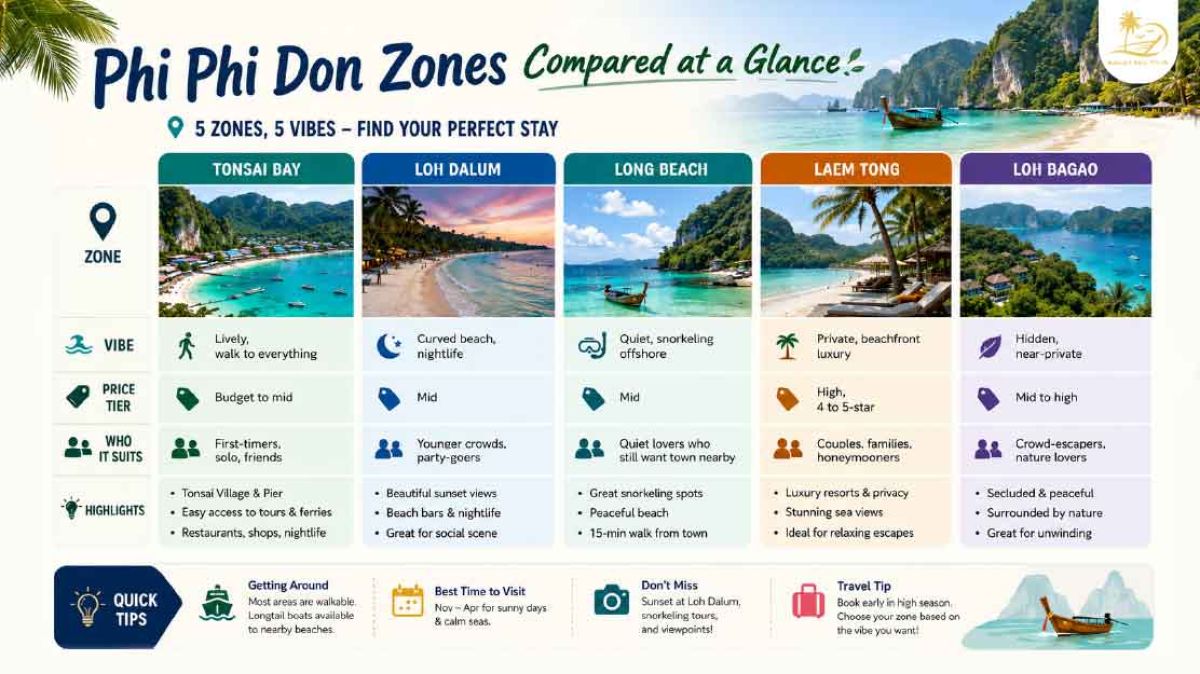
Tonsai Bay: The Heart of the Island Where You Can Walk Everywhere
Tonsai Bay holds the main pier and the island's village. Most of the hotels, restaurants, shops, dive centers, and bars are packed in here. The big draw is that you can walk to everything in a few minutes. No boat ride needed.
Rooms here run mid-range to budget. You'll find hostels, guesthouses, and small hotels. This zone is great for first-timers, solo travelers, and groups of friends who want to be near the buzz. The trade-off is the noise. Bars and restaurants keep things loud at night. If you're a light sleeper, pick a room set back from the main walking path.
Loh Dalum: The Curved Bay for Night Owls
Loh Dalum sits on the other side of a narrow strip of land from Tonsai. It's about a three-minute walk across from the pier. The beach here is a pretty curved bay with shallow water. By day it's perfect for lounging and swimming. By night it turns into the island's main beach party spot.
Rooms here are mostly mid-range. This zone suits younger travelers and groups of friends who came to enjoy the nightlife. If you like a lively vibe and want to be close to both the beach and the restaurants in Tonsai, this spot works well. But if you came for peace and quiet, skip it.
Long Beach: Quieter, With Great Snorkeling Right Offshore
Long Beach is about 10 to 15 minutes from Tonsai by longtail boat, or a 30 to 40 minute walk along the shore. The big draw is the calm. It's much quieter than the center of the island. There's a coral reef close to shore, so you can snorkel and see fish without taking a boat anywhere.
Rooms here are mostly mid-range bungalows on the beach. This zone suits people who want quiet but still want to reach Tonsai when they feel like grabbing food or going out. One thing to know: longtail boats thin out at night, so plan your trips in and out. If you love waking up and snorkeling right in front of your room, you'll fall for this spot.
Laem Tong: The Far North Tip for People Who Want Privacy
Laem Tong sits at the far north tip of the island. It's home to the most private four and five-star resorts on Phi Phi Don. Most resorts here run their own boat to bring guests straight from the pier, so you never deal with the crowds in Tonsai at all.
This zone suits honeymooning couples and families who want quiet and top-tier service. The beach is calm, the water is clear, and there are few people around. The trade-off is the distance from the restaurants and shops in the center, so most guests eat and do activities inside the resort. If you came to fully switch off and don't want to go anywhere, Laem Tong is worth the price.
Loh Bagao: A Hidden, Quiet East-Coast Cove
Loh Bagao is on the east coast of the island. It's another quiet, tucked-away zone with just a few resorts spread along the beach. It feels like you almost have the sand to yourself.
Rooms here run mid-range to high-end. This zone suits people who want to escape the crowds but don't need the full five-star feel of Laem Tong. The mood is calm, and you can watch the sun rise over the sea in the morning. Fewer people know about this spot than the others, so it still feels wild and natural.
Phi Phi Don Zones Compared at a Glance
| Zone | Vibe | Price Tier | Who It Suits |
|---|---|---|---|
| Tonsai Bay | Lively, walk to everything | Budget to mid | First-timers, solo, friends |
| Loh Dalum | Curved beach, nightlife | Mid | Younger crowds, party-goers |
| Long Beach | Quiet, snorkeling offshore | Mid | Quiet lovers who still want town nearby |
| Laem Tong | Private, beachfront luxury | High, 4 to 5-star | Couples, families, honeymooners |
| Loh Bagao | Hidden, near-private | Mid to high | Crowd-escapers, nature lovers |
How Much Do Phi Phi Don Hotels Cost by Tier?
Room prices on Phi Phi Don depend on the tier and the season. In high season, from November to April, prices go up and rooms fill fast. Outside that window, prices drop and you can bargain more easily.
There are roughly three tiers. Hostels and dorm beds run about 300 to 700 baht a night. Bungalows and mid-range rooms run about 1,200 to 3,500 baht a night. Four and five-star resorts and beachfront rooms start around 5,000 baht and climb past 20,000 baht a night. The resorts in Laem Tong and private beachfront rooms sit at the very top of that range.
How Do You Book a Phi Phi Don Hotel and Get a Good Deal?
In high season, from November to April, the good rooms go fast. This is especially true for beachfront resorts and quiet zones like Laem Tong. Book weeks or even a month ahead. If you come in this window and book late, you may be left with noisy or overpriced rooms in Tonsai.
Cash matters a lot here. The island has few ATMs and they charge high fees. Many resorts in the far zones don't take cards, so bring enough cash. On top of that, far zones like Laem Tong and Loh Bagao have no convenience stores. Buy what you need in Tonsai or bring it with you.
The upside of staying overnight is the mornings and evenings. After the day-trip crowds leave the island, the beaches turn quiet and especially pretty. If you're still on the fence about staying over, read whether a Phi Phi day trip or overnight is worth it to compare clearly before you decide.
Before you book, also think about whether you'll stay on Phi Phi Don or head over to explore Phi Phi Le, because the two islands are very different. Reading how Phi Phi Don and Phi Phi Le differ helps you see why all the hotels are on Phi Phi Don only.
Plan Your Phi Phi Overnight With a Team That Knows Every Zone
Picking a room that fits your trip isn't easy if you've never been here. Railay Eco Tour is a local team born and raised in Krabi. We know every bay on Phi Phi Don. We know which zones are truly quiet at each time of year, and which ones are easy to reach based on your plan.
We help you build a trip that ties together the ride from Krabi to Phi Phi, getting onto the island, and the sea tours around it, all matched to the nights you're staying. Whether you want Laem Tong for quiet or Tonsai for convenience, we shape the route around the days you have left.
Check out the Phi Phi one-day tour to scout the island before you commit to staying over, or message our team to plan a full overnight trip in one place.
Coming to Phi Phi? Don't Miss These Zones to Stay
Phi Phi Don has rooms for every budget, but the heart of the choice is the zone, not just the price. Tonsai Bay suits first-timers who want to walk to everything. Loh Dalum suits the party crowd. Long Beach suits quiet lovers who still want to snorkel out front. And Laem Tong and Loh Bagao suit couples and families who want privacy.
Remember, there are no cars here. You walk or take a boat. Pick a zone based on what you want to wake up to. Then book ahead in high season, bring enough cash, and plan how you'll get onto the island. If you're not sure how to reach Phi Phi yet, read how to get to Phi Phi from Krabi or Phuket to start planning every step of your trip.
Frequently Asked Questions
Which zone on Phi Phi Don is best for first-timers?
Tonsai Bay is best for first-timers. It sits in the middle of the island, so you can walk to the pier, restaurants, shops, and dive centers in minutes without taking another boat. It also has rooms at every price level. This makes it the safest pick if you don't have a firm plan yet.
How much do Phi Phi Don hotels cost?
Hostels and dorm beds start around 300 to 700 baht a night. Bungalows and mid-range rooms run about 1,200 to 3,500 baht. Four and five-star beachfront resorts start around 5,000 baht and go up to 20,000 baht a night. Prices rise in high season, from November to April.
How far ahead should I book a Phi Phi Don hotel?
In high season, from November to April, book weeks or even a month ahead. Beachfront resorts and quiet zones like Laem Tong fill very fast. Book late and you may be left with pricey or noisy rooms in Tonsai. Outside high season, a few days ahead is usually enough.
Are there ATMs on Phi Phi Don?
There are ATMs, but only a few, and they charge high fees. Most sit near Tonsai Bay. Many resorts in the far zones don't take cards, so bring enough cash for the whole trip. This is especially true if you stay in Laem Tong or Loh Bagao, where there are no convenience stores.
Which zone is the quietest and most private on Phi Phi Don?
Laem Tong at the far north tip is the quietest and most private. It's home to four and five-star resorts with their own boat transfers. Another option is Loh Bagao on the east coast, with just a few resorts and few people. Both zones suit couples and families who want to escape the crowds.
References
- Wikipedia: Phi Phi Islands: geography and island layout
- Tourism Authority of Thailand: Phi Phi: official Krabi travel info
- Lonely Planet: Ko Phi Phi Don: zones and area overview
- Krabi Provincial Office: local government tourism resource
Poda Island is a small island in Krabi province, south of Ao Nang — roughly 20 to 30 minutes by longtail boat or about 15 minutes by speedboat. What stands out is the fine white sand and the water, which stays shallow on a long gentle slope.
 Railay Eco
Pileh Lagoon sits on Phi Phi Leh in Krabi province — a bay almost completely ringed by tall limestone cliffs, with one narrow gap for boats to pass through. No swell reaches inside, so the water sits still, and the white sand floor below reflects the light back as emerald. Every trip to Phi Phi Leh stops here, because it is only minutes from Maya Bay.
Railay EcoKrabi Airport sits roughly 15 kilometres from Krabi town and 30 to 40 minutes by road from Ao Nang. To reach Ao Nang you can take the airport bus, a shared minivan, a taxi, or a private transfer booked in advance. Railay is a different matter: it is a peninsula no road reaches, so you take a vehicle to a pier and then a boat. The mistake people make most often is landing late and finding the last boats into Railay already finished for the day. This guide covers each transport option, journey times, rough costs, and how to handle a late arrival.
Railay EcoNopparat Thara Beach is in Krabi town district, immediately west of Ao Nang — five to ten minutes away on foot or by car. It runs for several kilometres, holds far fewer people than Ao Nang, and has the national park headquarters sitting right on the sand. The detail most visitors miss: at the lowest tides a sandbar emerges and you can walk out to the small island offshore without a boat. It also serves as a departure point for some island routes, so it works both as a place to rest and as a way out to sea. This guide covers how it differs from Ao Nang, how to get there, and when to go.
Railay EcoHong Island belongs to Krabi province and sits inside Than Bok Khorani National Park, north of Ao Nang — roughly 30 to 40 minutes by speedboat, or about an hour by longtail. What makes it different from the other Krabi islands is the lagoon in its middle: a pool of water almost entirely enclosed by tall limestone cliffs, with one narrow opening that small boats can slip through when the tide is high enough.
Railay EcoThe Emerald Pool sits in Khlong Thom district, Krabi province, roughly 60 to 70 kilometres from Krabi town — about an hour to an hour and a half by car. It is a natural pool clear enough to see the sand on the bottom, coloured green-blue by minerals in the groundwater and the light filtering through the canopy. From the car park you walk about 800 metres along a forest path. The path is mostly flat and comfortable even with children or older travellers. Two places most people pair with it on the same day: the Hot Springs nearby, and the Blue Pool a further walk in from the Emerald Pool itself. This guide covers the route, the entrance, the walking distances, and when the water is at its clearest.
Railay Eco