




Best Month for Clear Water in Krabi: When the Sea Looks Like Glass
The sea in Krabi is clearest from February to April. You can see 15-25 meters underwater. Skies are clear, waves are small, and snorkeling is amazing. From May to October, it's monsoon season — the water gets cloudy from sediment. Visibility drops to just 5-10 meters. If you want the clearest water, plan your trip in the dry months.
Why Water Clarity Matters
Clear water changes everything. Your underwater photos look way better. Snorkeling is more fun. Even just looking down from the boat is magical. The difference between 10 and 25 meters of visibility? Huge.
When the water is super clear, you can see coral and fish from the surface. You don't even need to dive. In the clearest months, you can see the bottom 15 meters down — clearly.
Pro divers measure clarity with a number called "visibility." That's the distance you can see things underwater. Higher number = clearer water. Read more about Krabi's seasons and best travel months for context.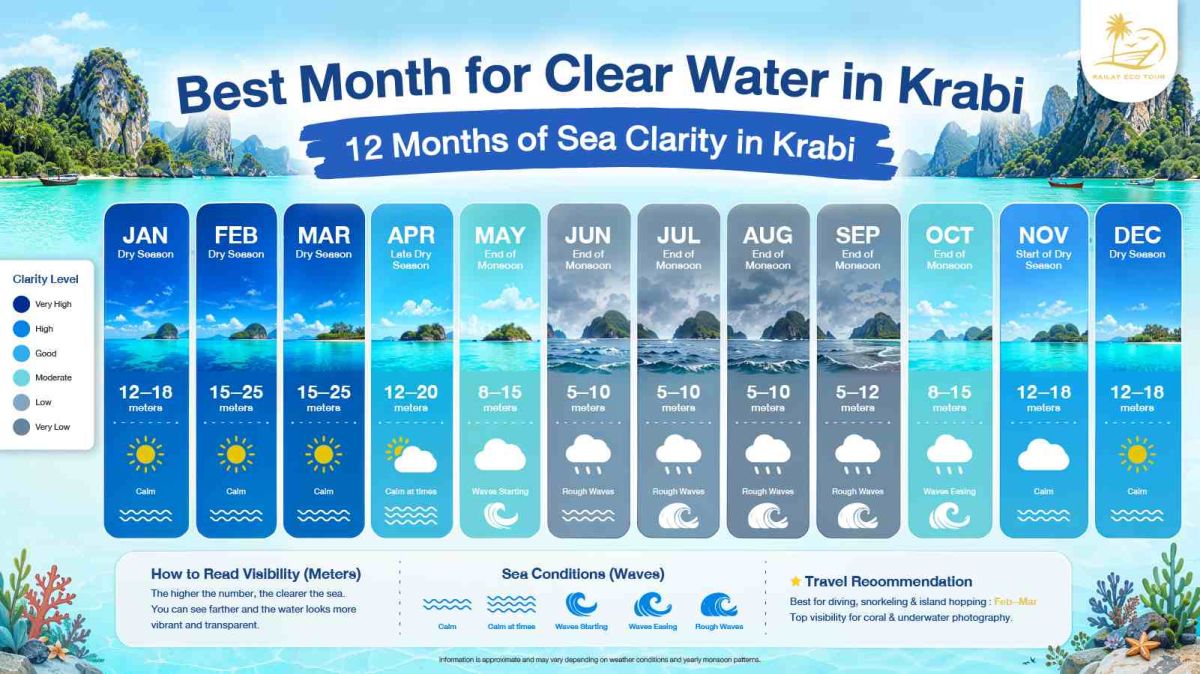
Krabi's Sea Through the Year
Here's a month-by-month breakdown:
| Month | Season | Visibility (m) | Waves | Clarity |
|---|---|---|---|---|
| Jan | Dry | 12-18 | Calm | Very clear |
| Feb | Dry | 15-25 | Calm | Best |
| Mar | Dry | 15-25 | Calm | Best |
| Apr | Late dry | 12-20 | Mostly calm | Clear |
| May | Early monsoon | 8-15 | Building waves | Medium |
| Jun | Monsoon | 5-10 | Strong waves | Low |
| Jul | Monsoon | 5-10 | Strong waves | Low |
| Aug | Monsoon | 5-10 | Strong waves | Lowest |
| Sep | Monsoon | 5-12 | Strong waves | Low |
| Oct | Late monsoon | 8-15 | Calming down | Medium |
| Nov | Early dry | 12-18 | Calm | Clear |
| Dec | Dry | 12-18 | Calm | Very clear |
You can see February and March are the absolute best.
Why Are Feb-March the Clearest?
A few reasons, actually:
Less Sediment in the Water
In dry season, there's not much rain. So less mud washes from rivers into the sea. The water stays clearer because nothing's floating around.
Calm Waves and Currents
Small waves mean the seafloor stays settled. No clouds of sand getting kicked up. Divers and snorkelers see coral and fish super clearly. Wave heights are just 0.5-1 meter — safe for swimming and boats.
Comfortable Water Temperature
Water hits 27-29°C (80-84°F). You can stay in the water for hours. No need for a wetsuit.
Better Sunlight Underwater
Clear skies mean strong sunlight reaches deep into the water. Your underwater photos pop with color. Coral and fish look detailed, not washed out.
The Clearest Spots in Krabi
Not every Krabi spot is the same. Even in the same month, some spots are clearer than others.
Poda Island
Poda has the clearest water of the 4 Islands. Visibility hits 12-20 meters in dry season. White sandy bottom reflects the light beautifully. The water looks emerald green. Perfect for photos and snorkeling.
Phi Phi Islands
Phi Phi Le and Maya Bay have Krabi's clearest water — period. Visibility reaches 15-25 meters in dry season. You can see coral and fish from the surface. But it gets crowded. Go before 9 AM if you want photos without people in them.
For the full story on Phi Phi, check out the Phi Phi Islands guide.
Hong Island and Phak Bia
Hong Island sits in a closed lagoon. So the water stays clear and calm year-round. Dry season visibility: 15-20 meters. Even in rainy season, it's still 8-12 meters. Way clearer than open spots.
Koh Rok (Inner and Outer)
Koh Rok is 2 hours from Krabi by speedboat. Visibility hits 20-30 meters. World-class diving. But you need a special diving tour to get there. Not for casual family trips.
Tips for Picking the Clearest Days
Even in clear months, some days are better than others.
Check for Rain the Night Before
If it rained hard last night, the water might be cloudy in the morning. River runoff brings mud. Check the weather forecast before you book a boat.
Time It With High Tide
At low tide, shallow areas near the shore can get murky. Sediment kicks up. Going at high tide gives you clearer water.
You can check tide tables online from the Hydrographic Department of the Royal Thai Navy.
Get to the Spot Before 10 AM
Early morning is the cleanest. Boats haven't churned up the water yet. Tourists are still at breakfast. The sediment hasn't been disturbed. Bonus: way fewer people for photos.
Avoid Days After Storms
Check the 5-7 day forecast. If a tropical storm or heavy rain is coming, the water stays cloudy for 2-3 days even after the rain stops.
Gear You Need for Clear Water Adventures
Basic snorkeling kit:
A snorkel set (mask, snorkel, fins). Rent for 100-200 baht per day. Or buy new for 600-1,500 baht.
A waterproof camera. GoPro or your phone in a waterproof case. Cases run 200-500 baht.
Reef-safe sunscreen — the kind that doesn't hurt coral. Many tour operators check your sunscreen before you board.
A quick-dry towel and waterproof bag for your phone and wallet.
Diving With Local Guides Who Know the Spots
Railay Eco Tour runs sea tours timed for the best season. Our guides know which spots stay clearest each day. We avoid crowded areas and rough water.
Our guides are certified divers. They take you to coral spots that are still healthy and water that's actually clear — not the famous spots packed with tourists.
For folks wanting healthy coral and clear water, check out the Hong Islands Full-Day Tour or Phi Phi Islands Full-Day Tour. Or contact us for diving advice based on the month you're visiting.
Quick Recap
Krabi's water is clearest from February to March. Visibility reaches 15-25 meters underwater. Perfect for snorkeling and photos.
The clearest spots? Phi Phi Le and Hong Island. Then Poda among the 4 Islands.
Plan your trip for February, March, or early April. Skip May-October if you want the clearest water. You'll have calm seas and crystal water.
Frequently Asked Questions
Should I skip Krabi during rainy season?
Not necessarily. Some spots stay clear in rainy season — like Hong Island (closed lagoon) and protected bays. Visibility drops to 8-12 meters versus 15-25 in dry season. Still totally fine for snorkeling, just not as wow.
Krabi vs Koh Samui — which has clearer water?
Krabi (Andaman side) is clearer than Samui (Gulf of Thailand side) by 5-10 meters on average. The Andaman is deeper with less sediment. But Krabi has a clear rainy season, while Samui gets rain spread across the whole year.
How does Krabi compare to the Maldives?
The Maldives wins by 5-10 meters of visibility. They're in the middle of the ocean — no continents nearby. But Krabi in its clearest months hits 25 meters. That's similar to Maldives in its average month. Krabi at its best is world-class.
Can I scuba dive in Krabi year-round?
Yes, but some spots close during monsoon season due to strong waves. Most Krabi dive schools adjust routes daily based on conditions. They pick spots in protected areas. So even in rainy season, you can dive — just at different spots.
What gear measures water clarity?
Divers use a "Secchi disk" — a black-and-white plate they lower into the water. Or just eyeball it. If you can see the sandy bottom 5 meters down clearly, it's good for snorkeling. Less than 5 meters? Scuba is fine but snorkeling won't show much.
References
- NOAA Coral Reef Watch: Weather and water conditions for coral reefs
- Wikipedia: The Andaman Sea
- Wikipedia: Phi Phi Islands
- Bangkok Post: Krabi travel feature
The full day vs half day tour choice comes down to three things: time, stops, and pace. A half-day tour runs about 4 to 5 hours, perfect for tight schedules, small kids, and older travelers. A full-day tour runs about 7 to 8 hours, visits more spots, and gives better value per stop. The 4 Islands half-day trip is a great example of the shorter style. This guide compares both so you can decide fast.
 Railay Eco
Planning a Krabi trip works best in this order: pick the month that matches your style, book your transport and a stay in the right zone, choose the islands and activities you really want, then book a Krabi tour operator with proper standards. This Krabi travel guide covers every step in one place, so you can plan the whole trip from a single page.
Railay EcoBefore you pay any Krabi tour operator, run these 7 checks: the company holds a tour operator license from the Department of Tourism, it has real reviews you can verify, prices clearly show what's included, boats meet safety standards with enough life jackets, guides are true locals, group size and tour type are stated clearly, and they reply fast and helpfully before you even book. If a company fails any of these, hold your money. This guide explains how to check each one, plus the warning signs that a scam is coming.
Railay EcoIs Krabi safe? Yes, it is safe for sea trips if you prepare the right way. Before you get on a boat, check 5 things: the season and weather, life jackets and boat standards, a tour with a proper tour operator license, your local guide's advice, and natural risks like currents and jellyfish. This guide walks you through each one. Lots of families planning a Krabi trip ask the same questions. Can my kids or my parents get on the boat? Will the sea be rough when we go? And how do I know the tour I book will really take care of us? We put all the answers in one place, based on years of running tours here. Read this once and you can plan the rest of your trip with confidence.
Railay Ecoใบอนุญาตทัวร์คือใบอนุญาตประกอบธุรกิจนำเที่ยวที่ออกโดยกรมการท่องเที่ยว กระทรวงการท่องเที่ยวและกีฬา ทัวร์ที่มีใบนี้แปลว่ารัฐรับรองว่าทำธุรกิจถูกต้อง มีหลักประกัน และตรวจสอบย้อนหลังได้ถ้าเกิดปัญหา บทความนี้อธิบายว่าใบอนุญาตคืออะไร ใครออกให้ ทำไมสำคัญ และวิธีเช็กก่อนจ่ายเงิน
Railay EcoSustainable tourism in Krabi starts with you. Pick a licensed operator, don't touch or step on coral, use reef-safe sunscreen, take your trash back, and support local people. These small choices add up. Together they help keep Krabi's sea and forests beautiful for the people who come after you. This guide covers the real things a traveler can do, plus why each one matters.
Railay Eco